Forgotten Light (Zapomenuté světlo) – Vladimír Michálek, 1996

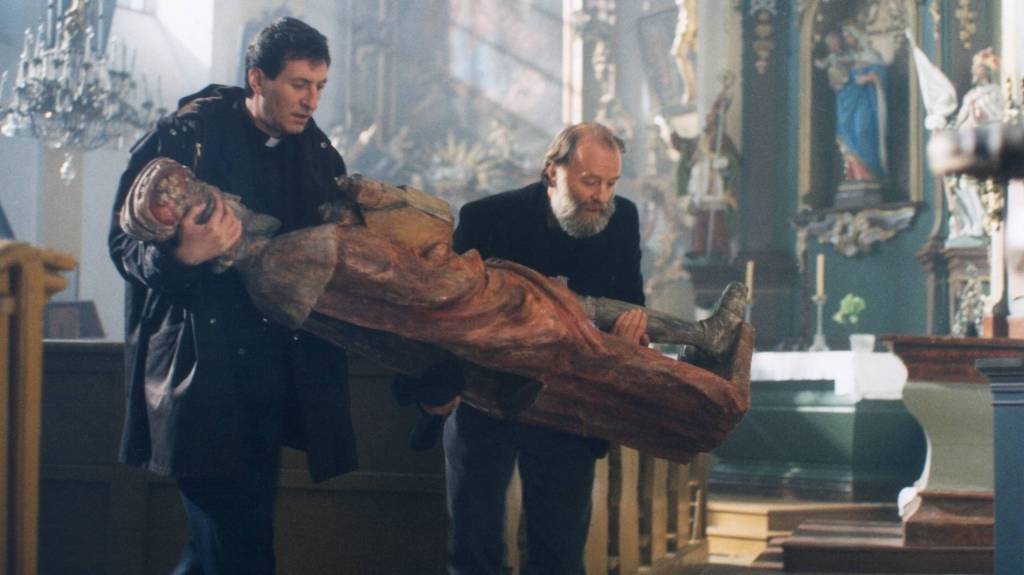
Father Holy and his sculptor friend carrying a religious statue in Forgotten Light

Father Holý (Bolek Polívka) is a modern village priest with a common touch, able to entertain his dwindling flock by framing his sermons as dreams he once had. In one of them, he relates the novel idea of walking into an abandoned church and finding God praying to humankind, desperate for proof of our continued existence.

This tale is a key moment in Forgotten Light, for while the film is ostensibly about a Catholic priest facing a crisis of faith at the butt end of the Communist regime in Czechoslovakia, it is ultimately more concerned with people’s ability to endure and maintain hope in Godless times.

Holý is a Regular Joe sort of priest, just as adept at fixing a motor as he is delivering Mass, and able to match the denizens of the village boozer shot for shot. His backstory suggests that he joined the priesthood for an easier life rather than a burning sense of piety, and he clearly still has a discreet eye for the ladies. He now has quite a lot of time on his hands – his parish once had three churches, but two have been shuttered by the state and converted into storage facilities. His last remaining place of worship is in a severe state of neglect, but he keeps on keeping on through a sense of duty to his small community.
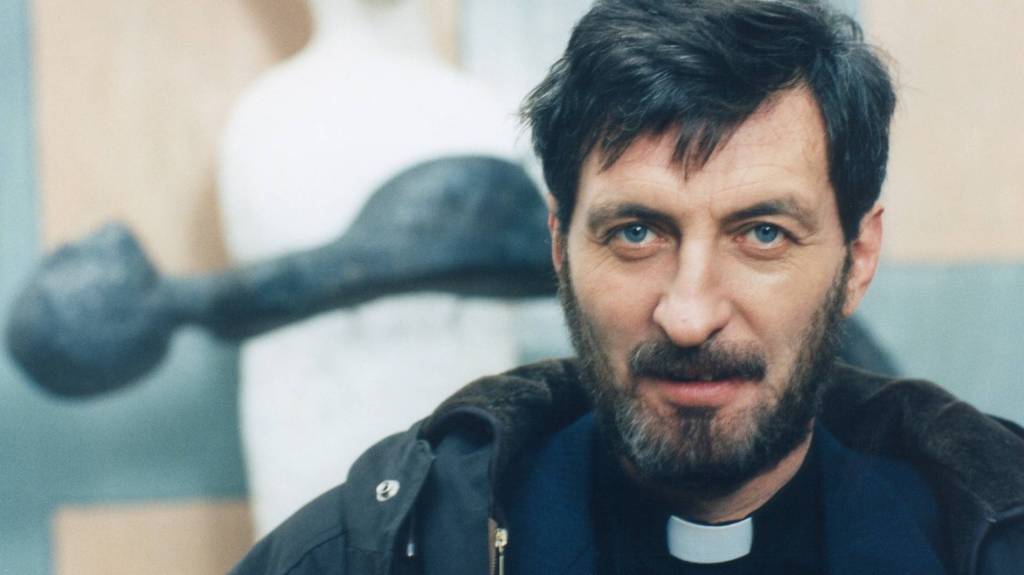
Bolek Polívka as doubting priest Father Holy in Forgotten Light

When the church springs a disastrous leak, Father Holý seeks funds to mend the roof. The atheistic Party is quite happy to let religion burn itself out through lack of funds and state support, however, and the seedy purse-keepers insinuate that he could get himself in a lot of trouble if he keeps pushing.

Holý’s a resourceful guy and hatches a risky scheme to raise the money himself, enlisting local sculptor Klima (Jiří Pecha) to carve a duplicate statue of St. Henry so he can flog the original to a wealthy foreign collector of religious artwork. Meanwhile, the priest also becomes involved in the plight of Marjánka (Veronika Žilková), a terminally ill woman he has long held a candle for.

Continue reading “Forgotten Light (Zapomenuté světlo) – Vladimír Michálek, 1996”
Coach to Vienna (Kočár do Vídně) – Karel Kachyňa, 1966

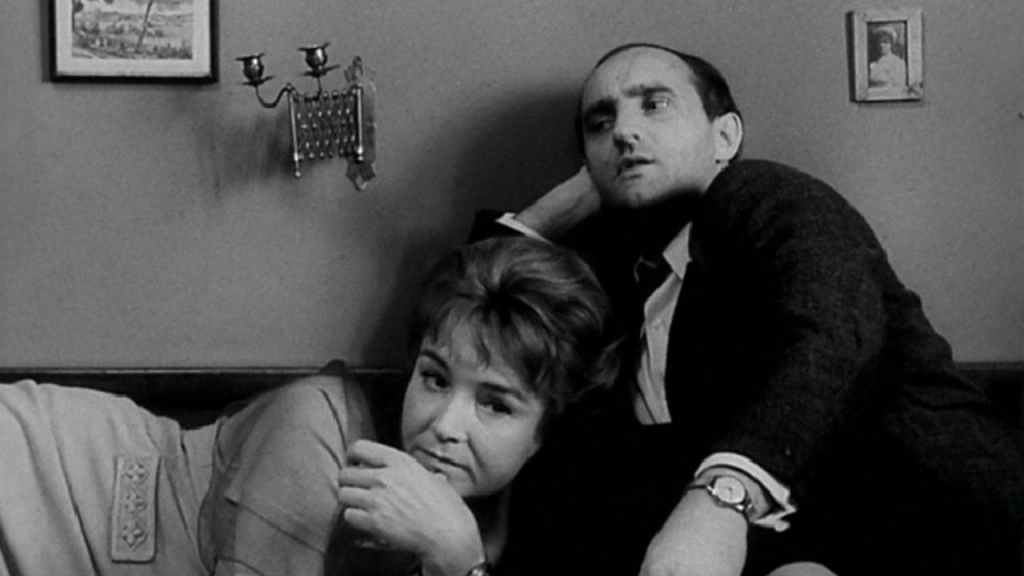
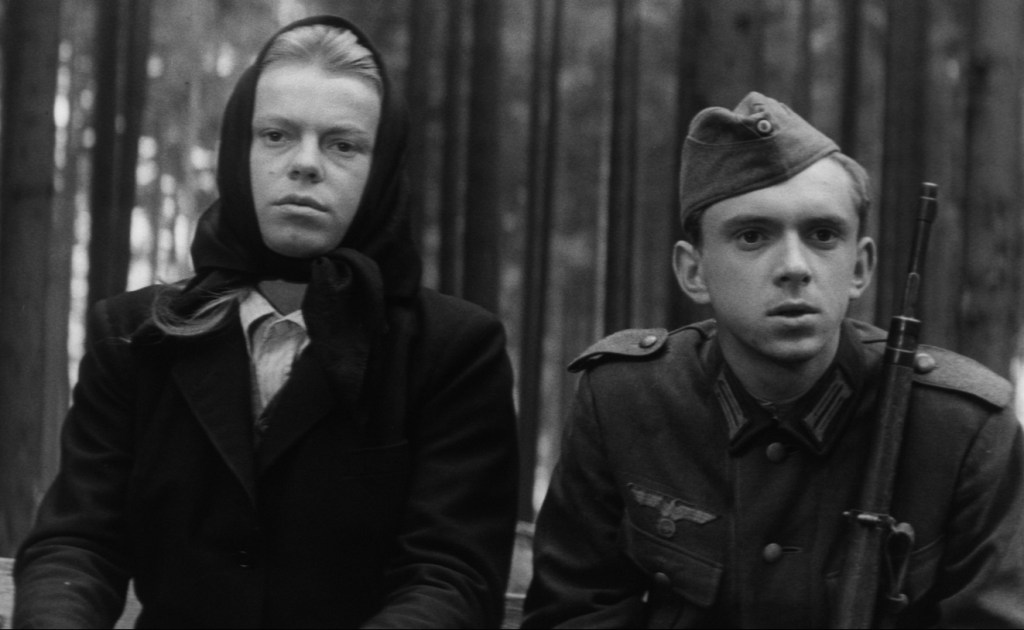
A grieving widow riding next to a German soldier on a horse-drawn cart in Coach to Vienna

We’re all familiar with the adage that war makes monsters out of men, and we’ve had numerous gruelling cinematic epics like Apocalypse Now and Come and See to hammer that point home. Before both those towering achievements, however, Czechoslovak New Wave director Karel Kachyňa succinctly showed that women are not exempt in his gripping drama Coach to Vienna.

Filmed during a period when the leading lights of the New Wave were largely focusing their talents on critiquing the Communist regime, Kachyňa’s film touches upon a shameful aspect of Czech history that came before. Much like František Vláčil’s sombre masterpiece Adelheid (1970), we’re dropped into the chaos and violence that accompanied the liberation of Czechoslovakia at the end of World War II, and the film nods toward the expulsion, mistreatment, and execution of ethnic Germans in the immediate aftermath.

An opening title card sets up the story: Retreating German forces have executed a farmer for a petty offence, and his widow, Krista (Iva Janžurová), is forced at gunpoint to transport two deserting soldiers by horse and cart to safety across the border in Austria. Her passengers are mortally wounded Günther (Luděk Munzar) and his callow young comrade Hans (Jaromír Hanzlík). Taking the rutted tracks through misty forests haunted by Czech partisans, it is a slow ride to sanctuary – and Krista has only revenge on her mind…

Continue reading “Coach to Vienna (Kočár do Vídně) – Karel Kachyňa, 1966”

Borders of Love (Hranice lásky) – Tomasz Wiński, 2022

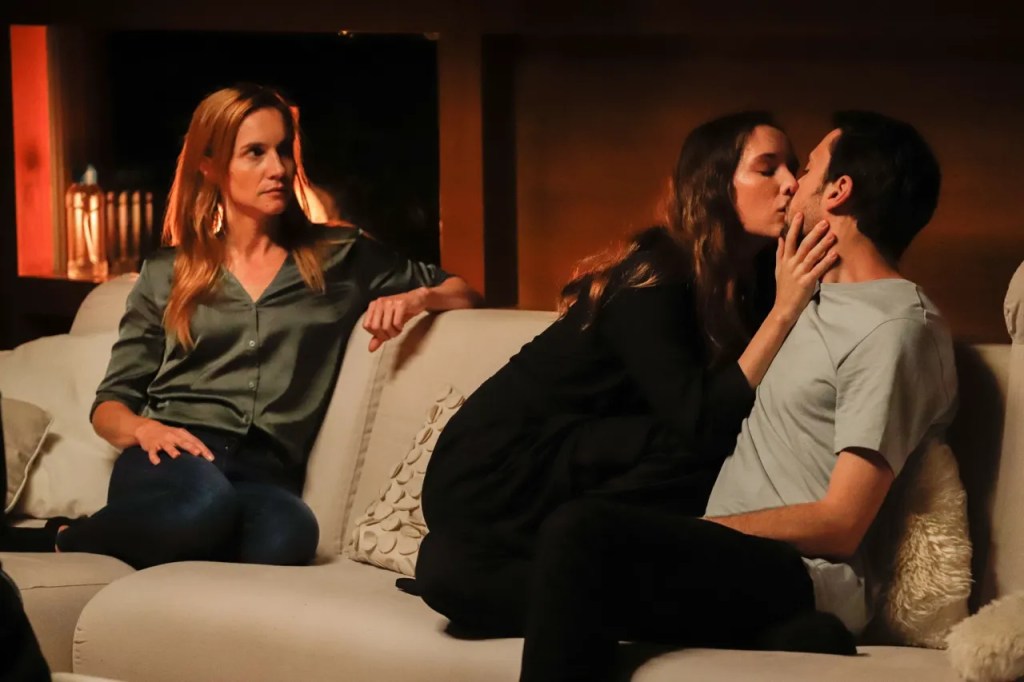
Hana looks on uneasily as her boyfriend makes out with another woman

I’ve only just revived this blog after an almost five-year absence, so it’s fair to say that I’m a little out of touch when it comes to more recent Czech cinema. So I did a search on IMDb, and what’s this wedged between two stone-cold classics in any language, Valerie and Her Week of Wonders and The Cremator? Tomasz Wiński’s erotic drama Borders of Love.

It certainly looks pretty racy from the poster, which depicts the lead actress Hana Vagnerová (Bikers) naked in the throes of ecstasy as she apparently takes on three guys. But those hairy-palmed viewers out there should put down the box of Kleenex, because that poster art is about as raunchy as it gets.

Instead, we get a rather dry Czech blend of Steven Soderbergh’s Sex, Lies, and Videotape and Lars von Trier’s Nymphomaniac, but one that is neither as perceptive as the former nor as in-your-face provocative as the latter.

We meet Hana (Vagnerová) and Petr (Matyáš Řezníček), a photogenic, progressive, and sexually active Prague couple who start delving into each other’s fantasies during pillow talk. They get onto the subject of sleeping with other partners, and Petr is far more enthusiastic about the idea at first. However, when they begin experimenting with swinging friends and casual hook-ups, Hana starts enjoying herself far more than Petr’s fragile ego can handle, with predictably fraught consequences for their relationship…

Continue reading “Borders of Love (Hranice lásky) – Tomasz Wiński, 2022”

The Joke (Žert) – Jaromil Jireš, 1969

Ludvik seducing Helena in The Joke

Streamlined from Milan Kundera’s novel of the same name into a trim 81-minute film, Jaromil Jireš’s The Joke is nevertheless one of the most forthright condemnations of Communism to emerge from the Czechoslovak New Wave. As a result, it was banned by the authorities shortly after its original run in 1969 and didn’t see the inside of a cinema again for another two decades.

Frankly, it’s remarkable that the film received a theatrical release at all. Unlike some other celebrated works of the period that took issue with the regime, The Joke doesn’t distance itself through allegory (such as Miloš Forman’s The Firemen’s Ball) or surrealism (Věra Chytilová’s Daisies). Those movies were censored, too, but Jireš’s quiet yet powerful adaptation of Kundera’s book comes right out and says it: People who didn’t toe the line (either wilfully or by misfortune) routinely had their lives shattered by the authorities.

The film opens as our cynical protagonist, Ludvik Jahn (Josef Somr), a middle-aged scientist and self-confessed womaniser, returns to his hometown in Moravia after a long absence. He meets Helena (Jana Dítětová), a reporter who wants to interview him for an article. By coincidence, she happens to be married to Pavel Zemánek (Luděk Munzar), a man Ludvik went to college with in Prague many years before. With this newfound knowledge, Ludvik decides he will seduce Helena to cuckold his old school chum and get belated revenge.

Continue reading “The Joke (Žert) – Jaromil Jireš, 1969”

Four Murders Are Enough, Darling (Čtyři vraždy stačí, drahoušku) – Oldřich Lipský, 1971

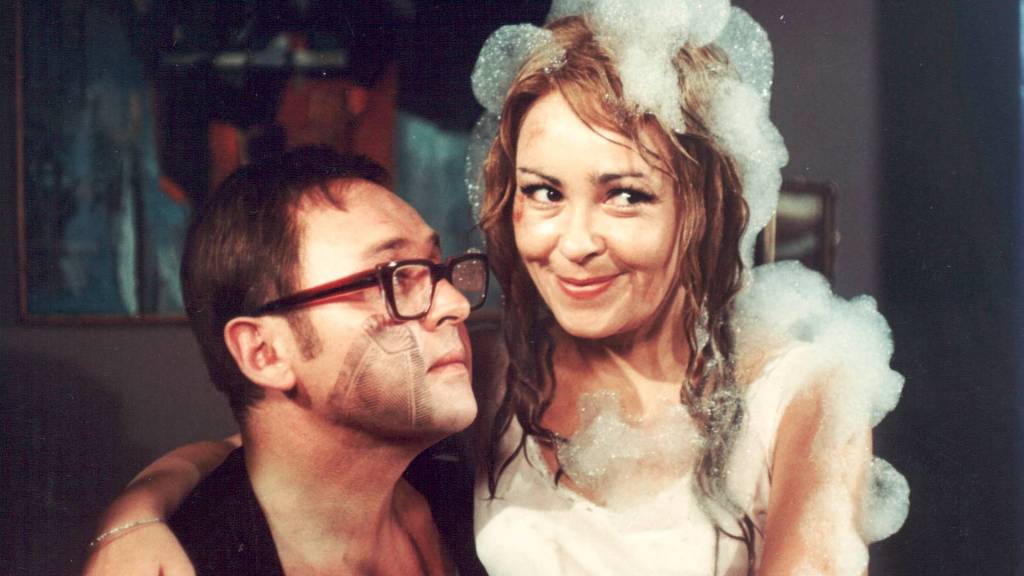
Lubomir Lipsky's hapless Georg Camel gazes at his love interest Sabrina, covered in soap suds, in Four Murders Are Enough, Darling

After parodying old-fashioned Hollywood cowboy movies in Lemonade Joe, the Czech Mel Brooks returned to affectionately lampooning American genres with Four Murders Are Enough, Darling. This time, classic crime flicks and pulp fiction are the targets, and Oldřich Lipský apparently never encountered a gag that he didn’t deem unworthy for inclusion in his movies. I say that in the best possible sense – here, the sheer deluge of broad jokes, irreverent wordplay, comic misunderstandings, and slapstick humour has a cumulative effect, rolled into a madcap farce with the purest intention: To make the audience laugh as often as possible.

Whether all the hilarity fully translates if you don’t speak Czech is another matter, but you’ll get the general vibe. The movie starts fast and sets the tone with a jaunty title sequence with evocatively dynamic comic book art by Kája Saudek. Then we’re on a night train where Dr. James Porter (Viktor Maurer), is nervously transporting a million-dollar cheque from Michago to San Fernando. Unfortunately for them, rival gangs from each city are also onboard with murderous designs on the loot.

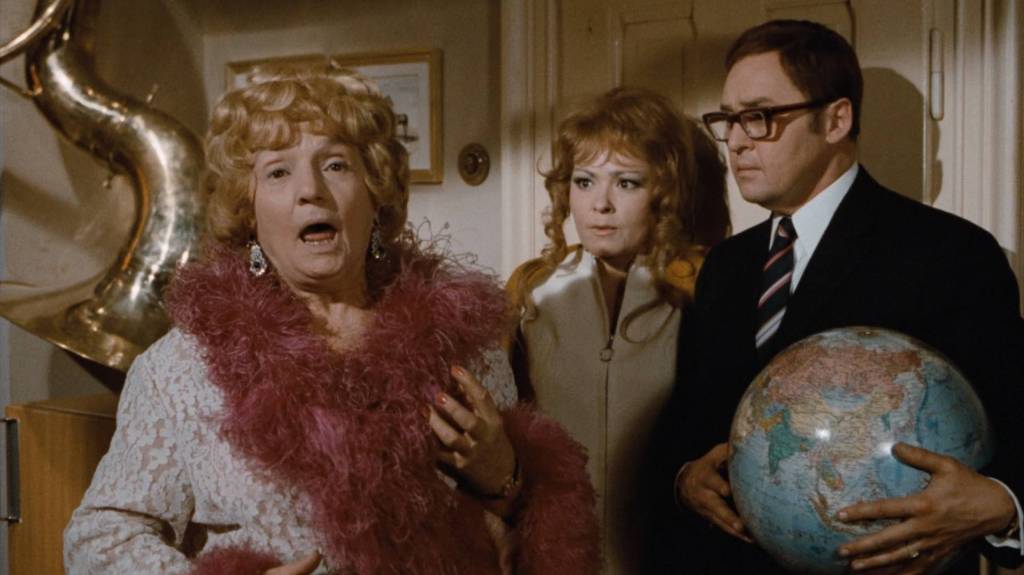
Segue to Springtown, where Lipský’s brother Lubomír (a regular actor in the director’s films) plays George Camel, a straight-laced school teacher with lofty literary ideals who doesn’t get much respect from his class – the kids would rather read comic books than Macbeth. He lives a solitary bachelor’s existence in a boarding house where he plays tuba and constantly gets nagged by his landlady, and tries to sell his highfalutin poetry to the local tabloid.

Lubomir Lipsky's George Camel in trouble with his nagging landlady again in Four Murders Are Enough, Darling

This is where he catches the eye of bored reporter Sabrina (Jiřina Bohdalová), who decides to woo George to make her roguish illustrator boyfriend jealous. George is excitedly getting ready for his hot date with her when the recently deceased Dr. Porter appears on his doorstep. Rather than call the police, however, George hastily stashes the stiff before Sabrina arrives.

Things escalate quickly as both gangs descend on the boarding house and take rooms, bumping each other off as they try to shake down George for the missing cheque. Already suspected of one murder by the bumbling cops, George arouses further suspicion when another dead body falls into his arms every time he opens a door. Initially setting out to clear his name by trying to find out who poisoned Dr. Porter, George grows to enjoy the notoriety as a feared killer and the increasingly amorous advances of Sabrina…

Continue reading “Four Murders Are Enough, Darling (Čtyři vraždy stačí, drahoušku) – Oldřich Lipský, 1971”

Prefab Story (Panelstory aneb Jak se rodí sídliště) – Věra Chytilová, 1979

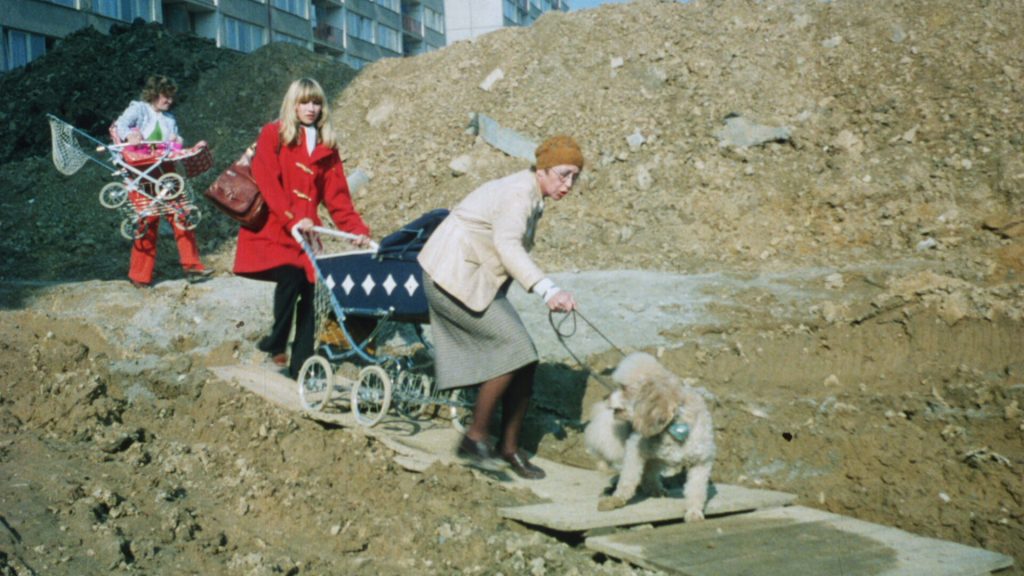
Residents struggle through the rubble in Prefab Story

When I first visited Prague at the tail end of the ’90s, I was captivated by the city to the extent that it dominated my every waking thought. Like for millions of tourists each year, it was the historic centre’s visual splendour that first set my heart racing, but it wasn’t long before I got to know the less postcard-friendly side as well.

Attending a teaching course in the freezing winter of early 2002, the school provided cheap digs in a Communist-era Panelák out in the Barrandov district – namely, a block of flats constructed from panels of prefabricated concrete. In truth, it didn’t look all that different from similar eyesores in Britain, but it was still a striking contrast to the “Golden City” image of Prague. Just as the towers, domes, and spires of the centrum appeared etched in crystal thanks to the crisp, cold January air, the stark right angles and brute bulk of the housing project were brought into sharp focus in the snow and ice.

There was heavy construction going on at the time, which meant a lot of rubble and heaps of earth for the locals to pick their way through as they went about their daily business. One night, my flatmate was staggering back from the pub when he fell into an open trench and lay unconscious as the falling snow began covering him up. Luckily, a passing group of teenagers spotted him, fished him out, and took him back to the pub for a few reviving rounds of beer and shots.

I was reminded of this incident continually while watching Prefab Story, Věra Chytilová’s tragicomic day-in-the-life of the vast Jižní Město housing estate in Prague. The narrative, such as it is, follows an elderly man who arrives from the countryside to live with his daughter in one of the concrete monstrosities, but neither the taxi driver nor the harried locals can pinpoint the correct tower block…

Continue reading “Prefab Story (Panelstory aneb Jak se rodí sídliště) – Věra Chytilová, 1979”