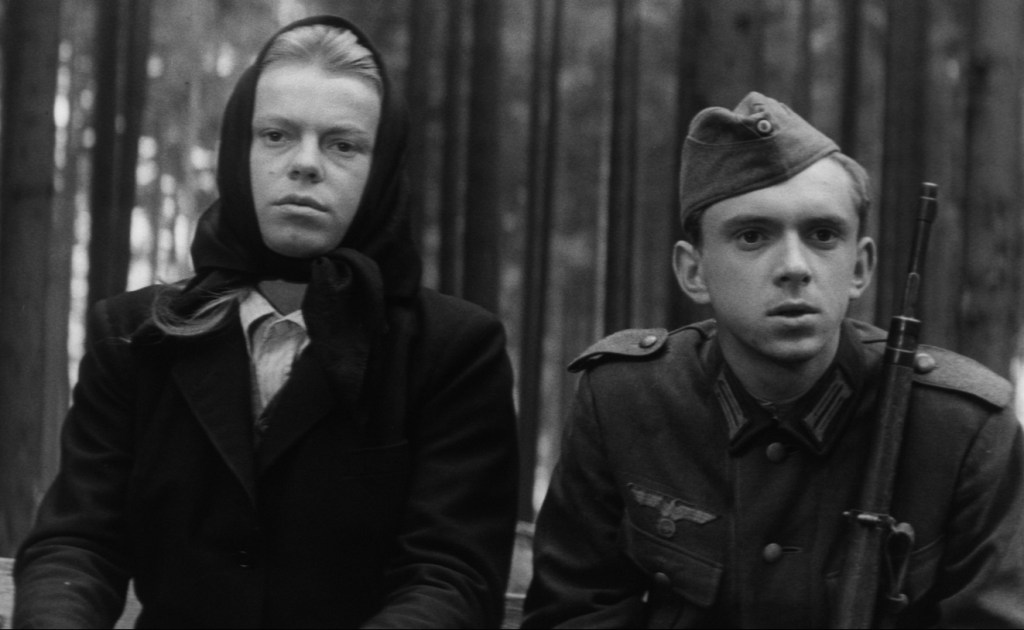
We’re all familiar with the adage that war makes monsters out of men, and we’ve had numerous gruelling cinematic epics like Apocalypse Now and Come and See to hammer that point home. Before both those towering achievements, however, Czechoslovak New Wave director Karel Kachyňa succinctly showed that women are not exempt in his gripping drama Coach to Vienna.
Filmed during a period when the leading lights of the New Wave were largely focusing their talents on critiquing the Communist regime, Kachyňa’s film touches upon a shameful aspect of Czech history that came before. Much like František Vláčil’s sombre masterpiece Adelheid (1970), we’re dropped into the chaos and violence that accompanied the liberation of Czechoslovakia at the end of World War II, and the film nods toward the expulsion, mistreatment, and execution of ethnic Germans in the immediate aftermath.
An opening title card sets up the story: Retreating German forces have executed a farmer for a petty offence, and his widow, Krista (Iva Janžurová), is forced at gunpoint to transport two deserting soldiers by horse and cart to safety across the border in Austria. Her passengers are mortally wounded Günther (Luděk Munzar) and his callow young comrade Hans (Jaromír Hanzlík). Taking the rutted tracks through misty forests haunted by Czech partisans, it is a slow ride to sanctuary – and Krista has only revenge on her mind…
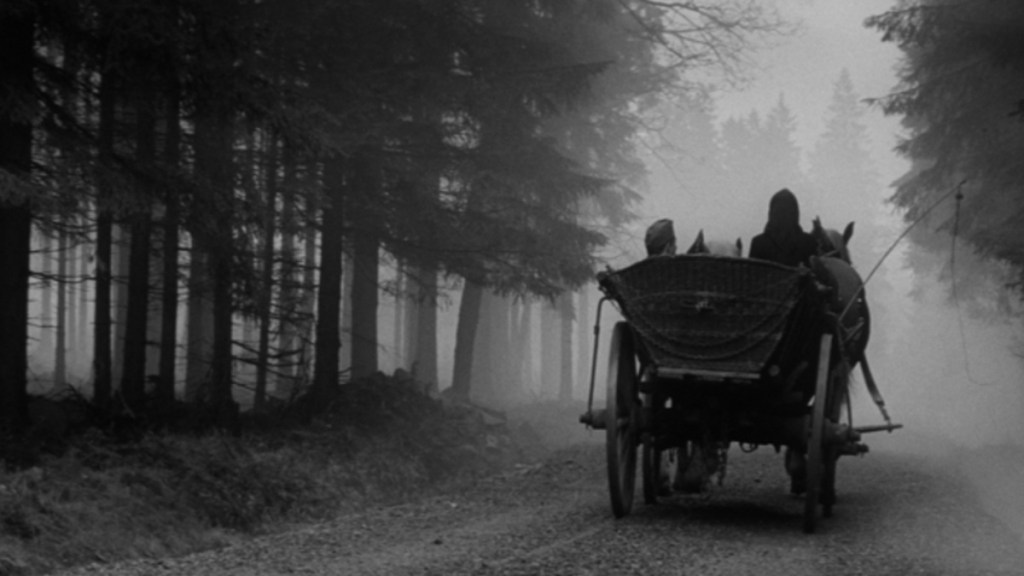
It’s a simple set-up with only three main characters, but Kachyňa expertly mines the premise for suspense. He lets us know early on, for instance, that Krista has an axe stowed under the cart, and we wait with bated breath as she surreptitiously tries to manipulate the tool into a position where she can use it against her would-be victims. But first, she needs to relieve them of a few vital items (a dagger, a pistol, and a compass), and the rule of three gives the film a fable-like aspect as they wend their way through the forest.
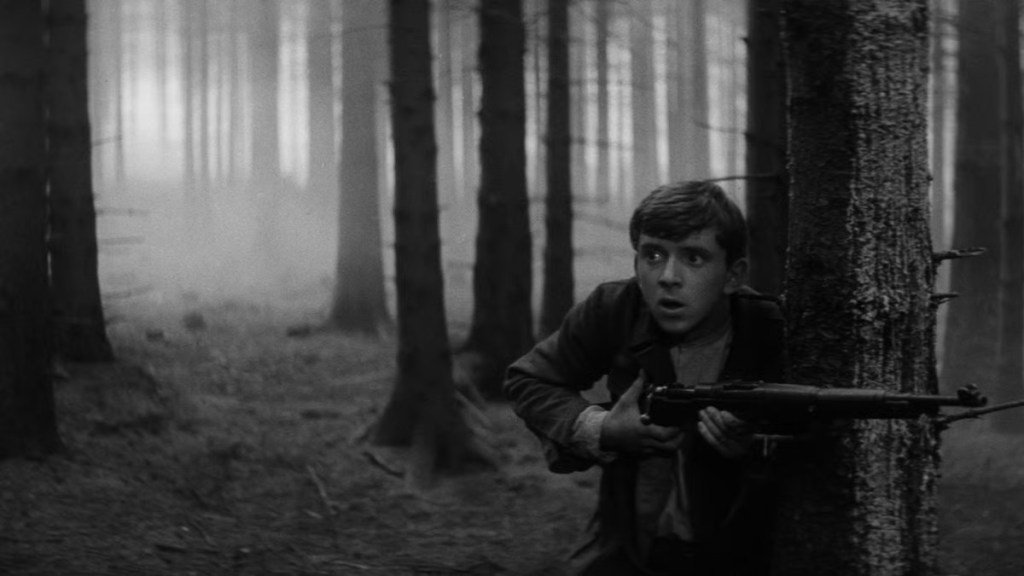
Movies set in the woods often smack of limited budgets and cost-cutting (just like films shot primarily in old warehouses), but Kachyňa makes the location an evocative backdrop for his tense drama. Shot in silky black and white by cinematographer Josef Illík, the verticality of the trees within the tight frame creates a claustrophobic effect, emphasising fear and entrapment. These woods are the stuff of dark European fairytales, and you can almost smell the rolling mists and damp earth.
With such a tiny cast, the performances need to be on point, and none of the three principal actors disappoints. Munzar has the least to do as the dying man in the back, but he gives us enough to know that, if he were fully fighting fit, Gunther would present a considerable threat to Krista. Hanzlík gives a sympathetic yet unsentimental portrait of a youthful, well-meaning conscript who just wants to get home to his wife and family in Vienna now that the war is over. He does most of the talking in the film, but not because he is necessarily a loquacious type. He chats away through giddy relief at being homeward bound, and to nervously fill the silence left hanging by his contemptuous captive.
Iva Janžurová gives a remarkable performance as Krista. Perhaps best known for her later comic roles (Four Murders Are Enough, Darling; Shotgun Justice, etc.) the actor is also capable of bravura dramatic turns (Morgiana), and she conveys such a range of emotions in a largely wordless part here. Although her face is set into an icy mask, she still reveals exactly what is going through Krista’s mind via subtle and fleeting expressions, helped immensely by sharp editing that lets us focus on crucial details from her point of view.
If these characters were shorn of context and backstory, Krista would almost come across as the villain of the piece, which is where Coach to Vienna becomes more provocative than a standard suspense drama. Made at a time when the official narrative leaned towards the moral high ground of Czech wartime suffering, Kachyňa dares to focus on a Czech protagonist who becomes cruel not by accident or circumstance, but through her conviction to carry out her murderous plan.
Krista’s trauma explains her behaviour, but it doesn’t absolve her. Revenge may feel justified, but it corrupts the soul with brutal efficiency. She is undoubtedly the victim, but the horrors of war have made her a monster, too. If the film has a fault, it’s that some character decisions late in the game carry the whiff of plot contrivance to get the story over the line, bordering on curiously Hollywood-esque. But Kachyňa and his co-screenwriter Jan Procházka manage to pull things out of the fire with an appropriately stark ending in keeping with the rest of the narrative.
Kachyňa’s refusal to give his protagonist a moral pass is a brave choice, and, as it turned out, a precarious one at the time. The film’s skepticism and ambiguity drew the ire of the authorities, and Coach to Vienna was banned after the Prague Spring was subdued by Warsaw Pact troops in 1968. Now it stands as a regularly overlooked gem of Czech cinema, ripe for rediscovery and discussion – and one that could teach many Hollywood directors a thing or two about making a suspenseful film with real substance.

 Czech Film Review