Forgotten Light (Zapomenuté světlo) – Vladimír Michálek, 1996

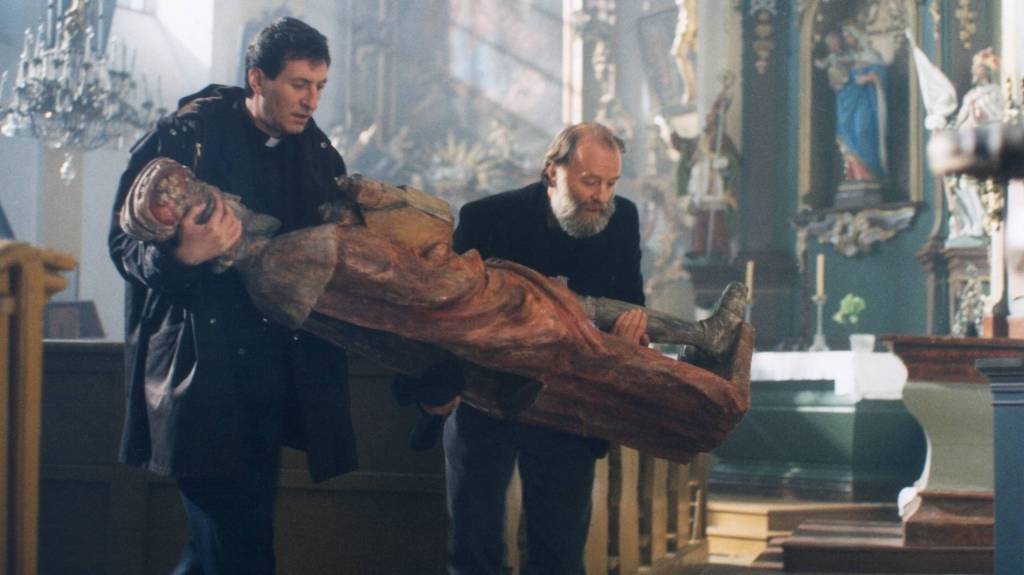
Father Holy and his sculptor friend carrying a religious statue in Forgotten Light

Father Holý (Bolek Polívka) is a modern village priest with a common touch, able to entertain his dwindling flock by framing his sermons as dreams he once had. In one of them, he relates the novel idea of walking into an abandoned church and finding God praying to humankind, desperate for proof of our continued existence.

This tale is a key moment in Forgotten Light, for while the film is ostensibly about a Catholic priest facing a crisis of faith at the butt end of the Communist regime in Czechoslovakia, it is ultimately more concerned with people’s ability to endure and maintain hope in Godless times.

Holý is a Regular Joe sort of priest, just as adept at fixing a motor as he is delivering Mass, and able to match the denizens of the village boozer shot for shot. His backstory suggests that he joined the priesthood for an easier life rather than a burning sense of piety, and he clearly still has a discreet eye for the ladies. He now has quite a lot of time on his hands – his parish once had three churches, but two have been shuttered by the state and converted into storage facilities. His last remaining place of worship is in a severe state of neglect, but he keeps on keeping on through a sense of duty to his small community.
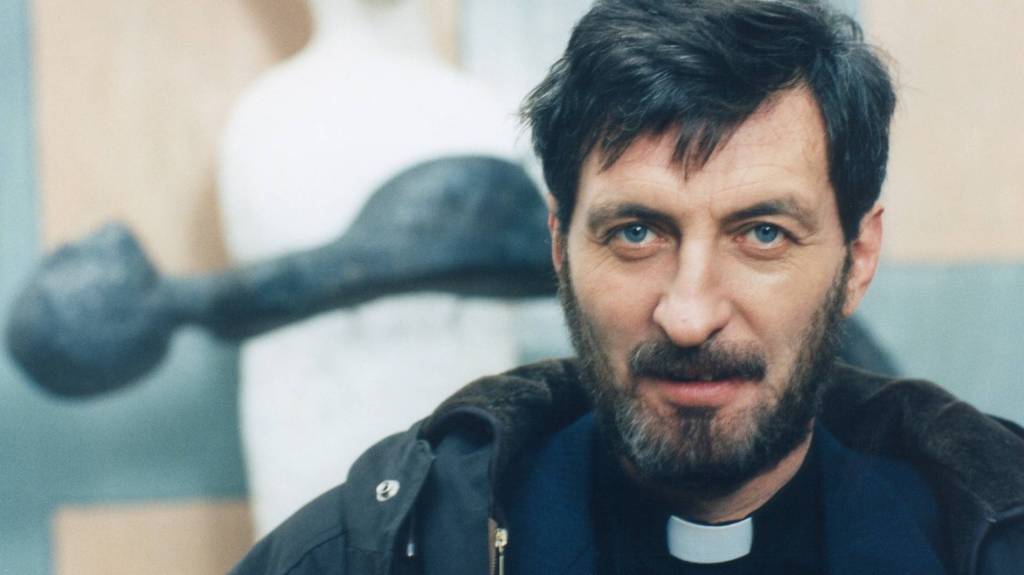
Bolek Polívka as doubting priest Father Holy in Forgotten Light

When the church springs a disastrous leak, Father Holý seeks funds to mend the roof. The atheistic Party is quite happy to let religion burn itself out through lack of funds and state support, however, and the seedy purse-keepers insinuate that he could get himself in a lot of trouble if he keeps pushing.

Holý’s a resourceful guy and hatches a risky scheme to raise the money himself, enlisting local sculptor Klima (Jiří Pecha) to carve a duplicate statue of St. Henry so he can flog the original to a wealthy foreign collector of religious artwork. Meanwhile, the priest also becomes involved in the plight of Marjánka (Veronika Žilková), a terminally ill woman he has long held a candle for.

Continue reading “Forgotten Light (Zapomenuté světlo) – Vladimír Michálek, 1996”
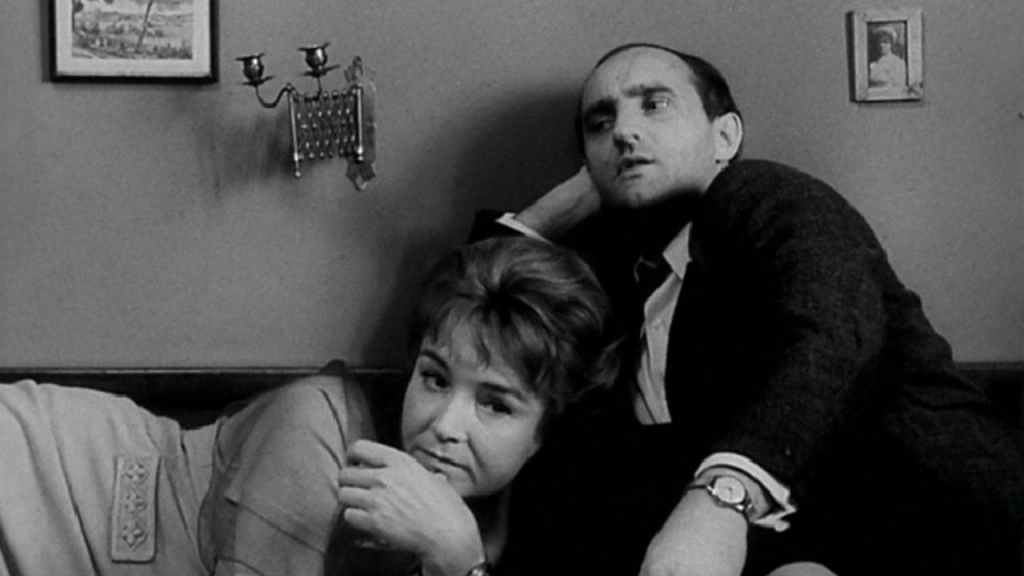
Coach to Vienna (Kočár do Vídně) – Karel Kachyňa, 1966

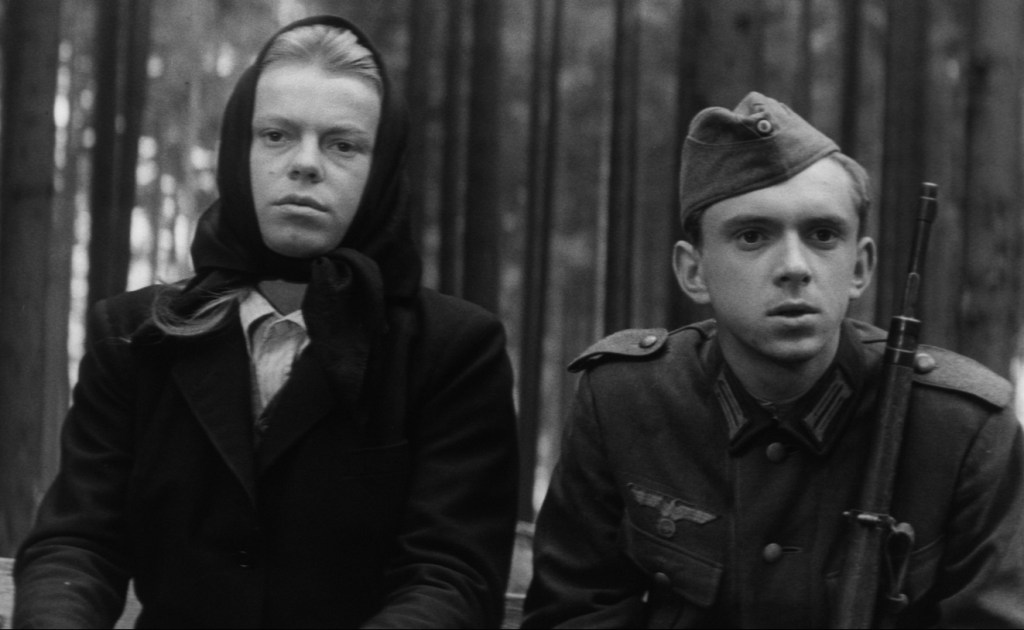
A grieving widow riding next to a German soldier on a horse-drawn cart in Coach to Vienna

We’re all familiar with the adage that war makes monsters out of men, and we’ve had numerous gruelling cinematic epics like Apocalypse Now and Come and See to hammer that point home. Before both those towering achievements, however, Czechoslovak New Wave director Karel Kachyňa succinctly showed that women are not exempt in his gripping drama Coach to Vienna.

Filmed during a period when the leading lights of the New Wave were largely focusing their talents on critiquing the Communist regime, Kachyňa’s film touches upon a shameful aspect of Czech history that came before. Much like František Vláčil’s sombre masterpiece Adelheid (1970), we’re dropped into the chaos and violence that accompanied the liberation of Czechoslovakia at the end of World War II, and the film nods toward the expulsion, mistreatment, and execution of ethnic Germans in the immediate aftermath.

An opening title card sets up the story: Retreating German forces have executed a farmer for a petty offence, and his widow, Krista (Iva Janžurová), is forced at gunpoint to transport two deserting soldiers by horse and cart to safety across the border in Austria. Her passengers are mortally wounded Günther (Luděk Munzar) and his callow young comrade Hans (Jaromír Hanzlík). Taking the rutted tracks through misty forests haunted by Czech partisans, it is a slow ride to sanctuary – and Krista has only revenge on her mind…

Continue reading “Coach to Vienna (Kočár do Vídně) – Karel Kachyňa, 1966”

Borders of Love (Hranice lásky) – Tomasz Wiński, 2022

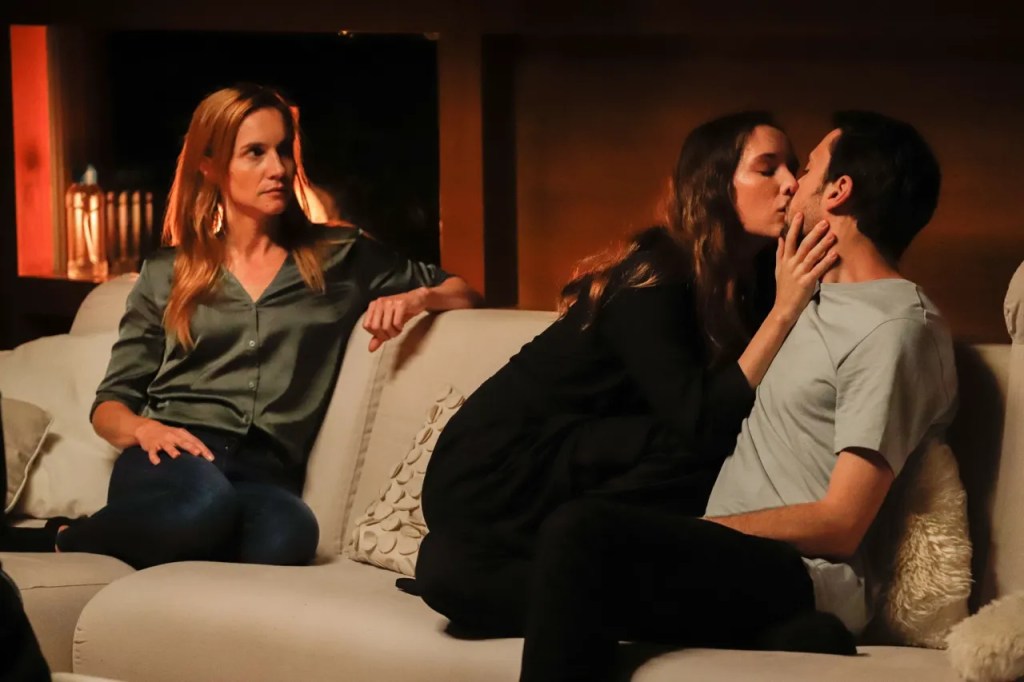
Hana looks on uneasily as her boyfriend makes out with another woman

I’ve only just revived this blog after an almost five-year absence, so it’s fair to say that I’m a little out of touch when it comes to more recent Czech cinema. So I did a search on IMDb, and what’s this wedged between two stone-cold classics in any language, Valerie and Her Week of Wonders and The Cremator? Tomasz Wiński’s erotic drama Borders of Love.

It certainly looks pretty racy from the poster, which depicts the lead actress Hana Vagnerová (Bikers) naked in the throes of ecstasy as she apparently takes on three guys. But those hairy-palmed viewers out there should put down the box of Kleenex, because that poster art is about as raunchy as it gets.

Instead, we get a rather dry Czech blend of Steven Soderbergh’s Sex, Lies, and Videotape and Lars von Trier’s Nymphomaniac, but one that is neither as perceptive as the former nor as in-your-face provocative as the latter.

We meet Hana (Vagnerová) and Petr (Matyáš Řezníček), a photogenic, progressive, and sexually active Prague couple who start delving into each other’s fantasies during pillow talk. They get onto the subject of sleeping with other partners, and Petr is far more enthusiastic about the idea at first. However, when they begin experimenting with swinging friends and casual hook-ups, Hana starts enjoying herself far more than Petr’s fragile ego can handle, with predictably fraught consequences for their relationship…

Continue reading “Borders of Love (Hranice lásky) – Tomasz Wiński, 2022”

The Joke (Žert) – Jaromil Jireš, 1969

Ludvik seducing Helena in The Joke

Streamlined from Milan Kundera’s novel of the same name into a trim 81-minute film, Jaromil Jireš’s The Joke is nevertheless one of the most forthright condemnations of Communism to emerge from the Czechoslovak New Wave. As a result, it was banned by the authorities shortly after its original run in 1969 and didn’t see the inside of a cinema again for another two decades.

Frankly, it’s remarkable that the film received a theatrical release at all. Unlike some other celebrated works of the period that took issue with the regime, The Joke doesn’t distance itself through allegory (such as Miloš Forman’s The Firemen’s Ball) or surrealism (Věra Chytilová’s Daisies). Those movies were censored, too, but Jireš’s quiet yet powerful adaptation of Kundera’s book comes right out and says it: People who didn’t toe the line (either wilfully or by misfortune) routinely had their lives shattered by the authorities.

The film opens as our cynical protagonist, Ludvik Jahn (Josef Somr), a middle-aged scientist and self-confessed womaniser, returns to his hometown in Moravia after a long absence. He meets Helena (Jana Dítětová), a reporter who wants to interview him for an article. By coincidence, she happens to be married to Pavel Zemánek (Luděk Munzar), a man Ludvik went to college with in Prague many years before. With this newfound knowledge, Ludvik decides he will seduce Helena to cuckold his old school chum and get belated revenge.

Continue reading “The Joke (Žert) – Jaromil Jireš, 1969”

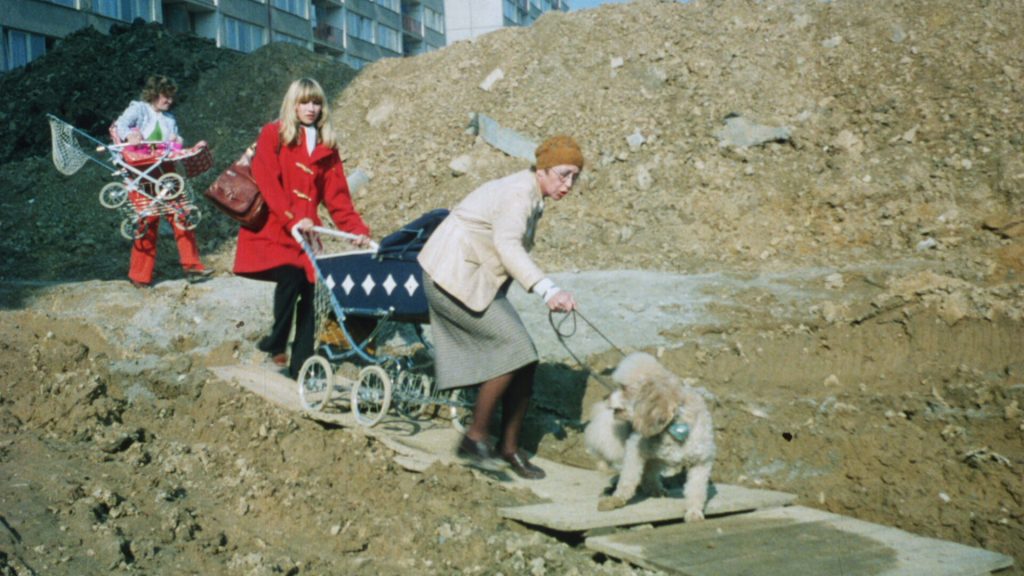
Prefab Story (Panelstory aneb Jak se rodí sídliště) – Věra Chytilová, 1979

Residents struggle through the rubble in Prefab Story

When I first visited Prague at the tail end of the ’90s, I was captivated by the city to the extent that it dominated my every waking thought. Like for millions of tourists each year, it was the historic centre’s visual splendour that first set my heart racing, but it wasn’t long before I got to know the less postcard-friendly side as well.

Attending a teaching course in the freezing winter of early 2002, the school provided cheap digs in a Communist-era Panelák out in the Barrandov district – namely, a block of flats constructed from panels of prefabricated concrete. In truth, it didn’t look all that different from similar eyesores in Britain, but it was still a striking contrast to the “Golden City” image of Prague. Just as the towers, domes, and spires of the centrum appeared etched in crystal thanks to the crisp, cold January air, the stark right angles and brute bulk of the housing project were brought into sharp focus in the snow and ice.

There was heavy construction going on at the time, which meant a lot of rubble and heaps of earth for the locals to pick their way through as they went about their daily business. One night, my flatmate was staggering back from the pub when he fell into an open trench and lay unconscious as the falling snow began covering him up. Luckily, a passing group of teenagers spotted him, fished him out, and took him back to the pub for a few reviving rounds of beer and shots.

I was reminded of this incident continually while watching Prefab Story, Věra Chytilová’s tragicomic day-in-the-life of the vast Jižní Město housing estate in Prague. The narrative, such as it is, follows an elderly man who arrives from the countryside to live with his daughter in one of the concrete monstrosities, but neither the taxi driver nor the harried locals can pinpoint the correct tower block…

Continue reading “Prefab Story (Panelstory aneb Jak se rodí sídliště) – Věra Chytilová, 1979”

A Bagful of Fleas (Pytel blech) – Věra Chytilová, 1962

A young woman perches on top of a wardrobe holding an umbrella in Věra Chytilová's A Bagful of Fleas

Perhaps more than any other film of the Czechoslovak New Wave, Věra Chytilová’s anarchic Daisies has transcended its origins and become an arthouse darling. The Criterion Collection hails it as “one of the great works of feminist cinema” and it is only one of two Czech movies to make the exalted Sight and Sound Top 250, the other being Marketa Lazarova. Over 50 years later, it still attracts attention from modern film buffs thanks to its absurd humour, zeitgeisty vibe and abundance of sixties style.

Chytilová made many other films, including the popular comedy The Inheritance or Fuckoffguysgoodday, but Daisies remains her most famous work. Sometimes when a director is so closely associated with one film it is fun to look back at their earlier catalogue to see how their style developed. With this in mind, I thought I’d check out her second short feature, A Bagful of Fleas

Continue reading “A Bagful of Fleas (Pytel blech) – Věra Chytilová, 1962”

Pearls of the Deep (Perličky na dně) – Jiří Menzel, Jan Němec, Evald Schorm, Věra Chytilová and Jaromil Jireš, 1966

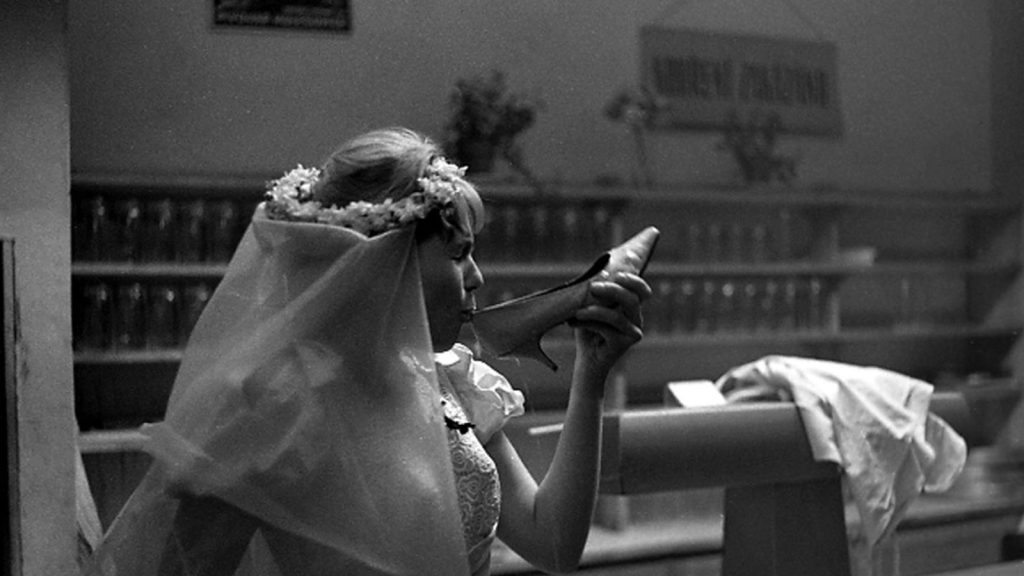
A young bride drinks champagne from her shoe in Pearls of the Deep

A subtitle for this anthology of short films based on the stories of Bohumil Hrabal may as well be “The Czechoslovak New Wave in a Nutshell”, as it showcases the work of five of the movement’s then up-and-coming directorial stars: Jiří Menzel, Jan Němec, Evald Schorm, Věra Chytilová and Jaromil Jireš. While the garrulous voice of the author comes through loud and clear in all segments, each director uses their tale as a framework for their burgeoning filmmaking talents.

First up is Menzel, who was the only one of the five who didn’t already have a full feature under his belt, but would go on to have a rewarding long-standing collaboration with Hrabal with films such as Closely Watched Trains, Cutting it Short and I Served the King of England. In The Death of Mr Baltazar, we follow three ageing petrolheads to a day at the Moto GP in their vintage 1931 Walter Convertible, a rickety old jalopy still capable of transporting six butchers and a bed. While the crowd wait for the race to start, they trade stories with another elderly spectator about all the horrific accidents they have witnessed. It’s almost as if they watch the sport to see which rider will come a cropper next and, sure enough, the day’s race adds another fatality to their highlight reel.

Continue reading “Pearls of the Deep (Perličky na dně) – Jiří Menzel, Jan Němec, Evald Schorm, Věra Chytilová and Jaromil Jireš, 1966”

Men in Hope (Muži v naději) – Jiří Vejdělek, 2011

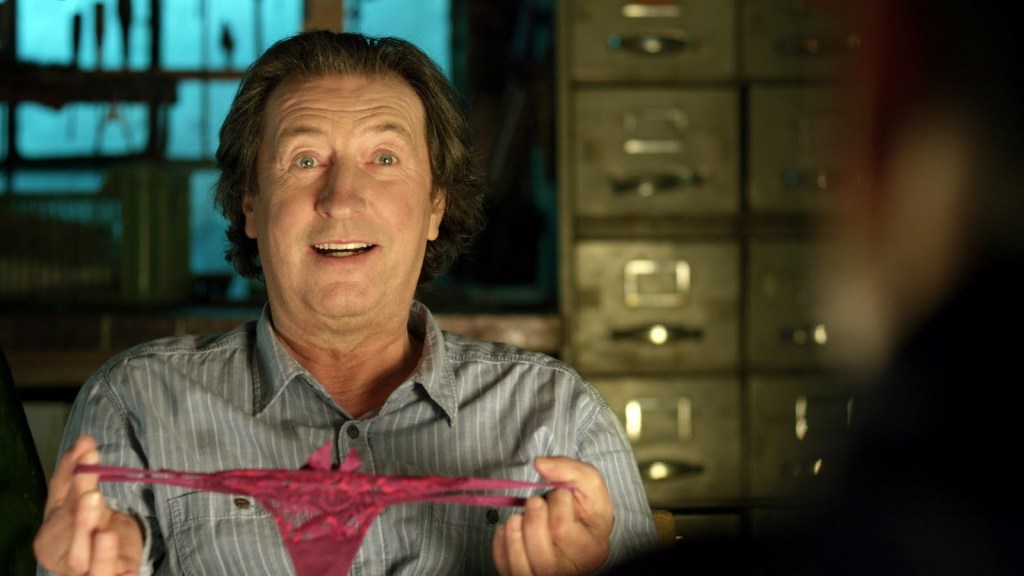
Bolek Polívka's Rudolf looks delighted as he holds a pair of skimpy women's panties in Men in Hope

As Ronan Keating, that perennial purveyor of pop pap, once sang: “Life is a rollercoaster, just gotta ride it” – that’s the happy-go-lucky ethos of Men in Hope‘s Rudolf (Bolek Polívka), an ageing lothario and Prague cabbie with 138 extra-marital affairs under his belt. He even had a very movie-land former career as an international rollercoaster designer, providing him ample opportunity to cheat on his wife, and gives us a handy metaphor for his attitude towards relationships. As a man who spent his life building fairground thrill rides, he knows all about the twists, turns, ups, downs and loop-the-loops that only an adulterous lifestyle can offer.

Rudolf reasons that a well-timed affair can save a relationship. He prides himself on never getting caught in over 35 years of marriage to his wife, Marta (Simona Stašová), and she benefits too. Having a series of flings with much younger women gives him a little extra energy when it’s time to perform his husbandly duties at home.

This philosophy is met with mild disapproval by Ondřej (Jiří Macháček), Rudolf’s downcast, browbeaten son-in-law, a former accountant who runs a failing restaurant with his frosty wife Alice (Petra Hřebíčková). Their marriage is stuck in a loveless rut, but Alice wants another baby and times their intimate moments accordingly. This puts pressure on Ondřej to come up with the goods as he worries about his fertility.

Things change when Ondřej meets Rudolf’s latest date, Šarlota (Vica Kerekes), a curvy red-headed bombshell who has been doing community service as penitence for dancing naked in a fountain. She has a special way of putting a smile on a guy’s face, and despite his misgivings, Ondřej can’t help but brighten up in her presence.

Before we know it, Šarlota tracks Ondřej down to his customer-free restaurant and starts an affair with him. Cheating on his wife peps Ondra up – he suddenly starts taking pride in his business, showing a little flair in the kitchen, as well as finding a bit more va-va-voom in the bedroom. Rudolf’s philosophy seems to be paying dividends when a sudden tragic event changes his point of view…

Continue reading “Men in Hope (Muži v naději) – Jiří Vejdělek, 2011”

Insect (Hmyz) – Jan Švankmajer, 2018

A menacing man holding a knife and wearing a balaclava with comic bug antennae in Jan Svankmajer's Hmyz

Once on a family holiday, we were walking around the side streets of a small Welsh town when we stumbled upon an old bric-a-brac shop that was closed for many years. Among the dusty collection of forlorn objects in the window display sat a vintage doll with braided hair, a straw hat, and a yellowed cotton dress. Her cheeks were webbed with tiny cracks and one of her eyes was missing. With her remaining eye, she gazed out across the universe like a martyr in a medieval painting. A huge dead spider lay curled up in her lap.

That image really troubled my childhood imagination, filled me with a terrible sense of nausea. It is the same feeling I got years later when I first saw Jan Švankmajer’s Jabberwocky, which is celebrating its 50th anniversary this year. His use of musty found objects in his animation, including dolls like the one sitting in that shop window years ago, disturbs me to this day.

Strangely I consider this a good thing, and with this in mind, I thought I’d check out Švankmajer’s final film, Insects. The blurb states that it is based on the play Pictures from the Insects’ Life by Karel and Josef Čapek, although that is a little misleading. The film finds Švankmajer in a playful mood, seemingly determined to do everything apart from shoot a straightforward adaptation of the satirical work.

After a cold open where we see a middle-aged man dressed in bug wings and goggles hurrying along the street, Švankmajer appears before the camera himself to provide a foreword for his new feature. The brothers Čapek wrote the play in 1924 while Hitler was sitting in a pub scheming his terrible schemes and Lenin was building his first gulags. Meanwhile, the Czechs and Slovaks were enjoying their newly founded republic, and people found the Čapek’s play a bit too pessimistic for the times. It was sheer youthful misanthropy, he tells us, and only gained greater relevance as the momentous events of the 20th century unfolded. 

All very interesting, you might think, and this foreword certainly whetted my appetite for the adaptation that was to follow. However, that is when Švankmajer goes deliberately off-script, flunking his lines and warning us of the chaos to follow…

Continue reading “Insect (Hmyz) – Jan Švankmajer, 2018”

A Report on the Party and the Guests (O slavnosti a hostech) – Jan Němec, 1966

Guests at a large banquet in the forest toast the viewer in Jan Nemec's A Report on the Party and the Guests

Political satire can take many forms, but sometimes all that’s required is some actors, a few tables and chairs, and a patch of woodland. That’s all Jan Němec needed for A Report on the Party and the Guests, his abstract but high impact critique of life under communist rule in Czechoslovakia. It was considered scathing enough that it allegedly had Antonín Novotný, the president at the time, climbing the walls.

The concept of A Report on the Party and the Guests is about as simple as it gets. A group of middle-aged, middle-class lovers are having a picnic in a peaceful glade on a hot summer’s day. There is plenty of food and drink to go around, the weather is warm, and the friends are enjoying each other’s company. After freshening up in a babbling brook, the group are accosted by a shady little man in squeaky shoes – we later find out his name is Rudolf (Jan Klusák) – and his thuggish-looking cohorts.

Rudolf and his gang bundle the picnickers away to a clearing where he subjects them to an impromptu interrogation. The group are separated into men and women and locked up in an imaginary prison marked by a line drawn in the dirt, with two rocks representing a door.

The picnickers uneasily play along with Rudolf’s game for a while, with Josef (Jiří Němec) acting as their spokesperson. Conversely, Karel (Karel Mareš) gets fed up and grumpily storms off, crossing the line of their prison. In response, Rudolf instructs his mob to chase after the escapee and torment him a bit.

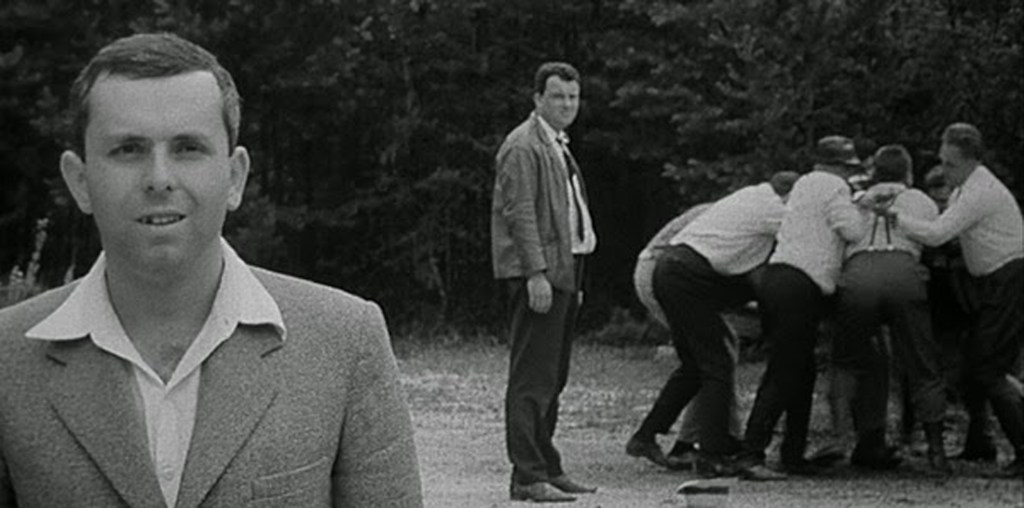
Two men look directly at the camera as a scuffle unfolds in the background in A Report on the Party and the Guests

The game is interrupted by a suave older gent in a shining white jacket, known only as the Host (Ivan Vyskočil). He apologises for Rudolf’s actions and charms the group, especially the ladies, and invites them to his birthday banquet by the lake. The picnickers are quickly intermingled with the other guests when they are all assigned seating away from each other. Any complaints are forgotten with the plentiful food and drink on offer, and Josef is rewarded for his attempt to parley with a seat at the head table.

As the celebrations progress, it soon becomes apparent that one of the picnickers, a taciturn man who quietly refused to suck up to the Host previously, has discreetly left the party…

Continue reading “A Report on the Party and the Guests (O slavnosti a hostech) – Jan Němec, 1966”