The Joke (Žert) – Jaromil Jireš, 1969

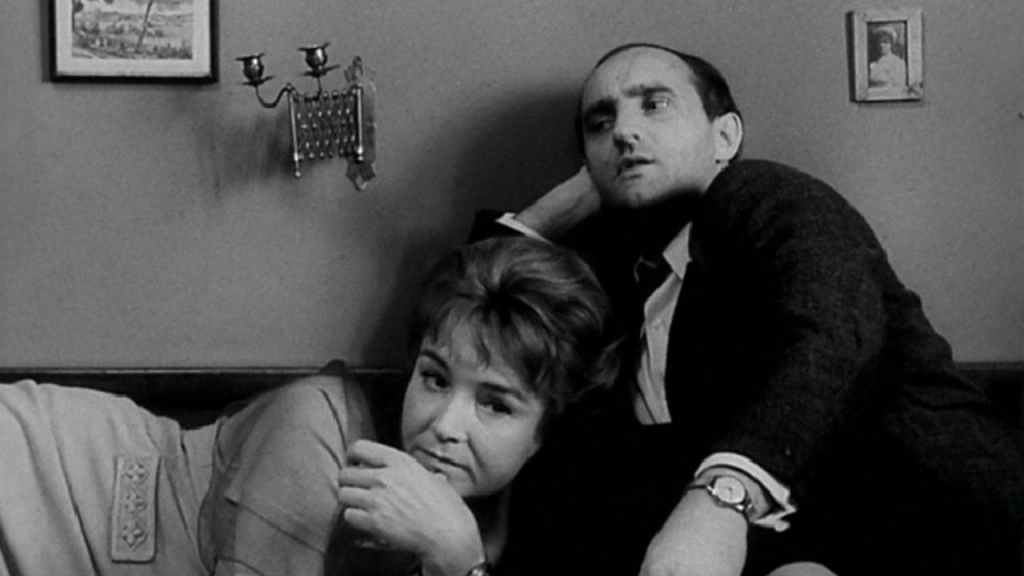
Ludvik seducing Helena in The Joke

Streamlined from Milan Kundera’s novel of the same name into a trim 81-minute film, Jaromil Jireš’s The Joke is nevertheless one of the most forthright condemnations of Communism to emerge from the Czechoslovak New Wave. As a result, it was banned by the authorities shortly after its original run in 1969 and didn’t see the inside of a cinema again for another two decades.

Frankly, it’s remarkable that the film received a theatrical release at all. Unlike some other celebrated works of the period that took issue with the regime, The Joke doesn’t distance itself through allegory (such as Miloš Forman’s The Firemen’s Ball) or surrealism (Věra Chytilová’s Daisies). Those movies were censored, too, but Jireš’s quiet yet powerful adaptation of Kundera’s book comes right out and says it: People who didn’t toe the line (either wilfully or by misfortune) routinely had their lives shattered by the authorities.

The film opens as our cynical protagonist, Ludvik Jahn (Josef Somr), a middle-aged scientist and self-confessed womaniser, returns to his hometown in Moravia after a long absence. He meets Helena (Jana Dítětová), a reporter who wants to interview him for an article. By coincidence, she happens to be married to Pavel Zemánek (Luděk Munzar), a man Ludvik went to college with in Prague many years before. With this newfound knowledge, Ludvik decides he will seduce Helena to cuckold his old school chum and get belated revenge.

Continue reading “The Joke (Žert) – Jaromil Jireš, 1969”
Prefab Story (Panelstory aneb Jak se rodí sídliště) – Věra Chytilová, 1979

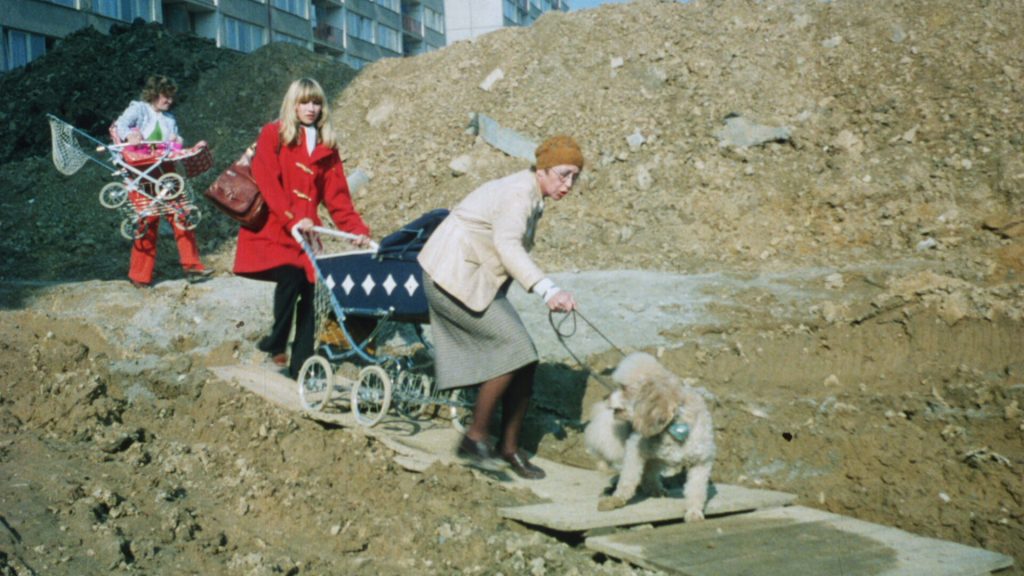
Residents struggle through the rubble in Prefab Story

When I first visited Prague at the tail end of the ’90s, I was captivated by the city to the extent that it dominated my every waking thought. Like for millions of tourists each year, it was the historic centre’s visual splendour that first set my heart racing, but it wasn’t long before I got to know the less postcard-friendly side as well.

Attending a teaching course in the freezing winter of early 2002, the school provided cheap digs in a Communist-era Panelák out in the Barrandov district – namely, a block of flats constructed from panels of prefabricated concrete. In truth, it didn’t look all that different from similar eyesores in Britain, but it was still a striking contrast to the “Golden City” image of Prague. Just as the towers, domes, and spires of the centrum appeared etched in crystal thanks to the crisp, cold January air, the stark right angles and brute bulk of the housing project were brought into sharp focus in the snow and ice.

There was heavy construction going on at the time, which meant a lot of rubble and heaps of earth for the locals to pick their way through as they went about their daily business. One night, my flatmate was staggering back from the pub when he fell into an open trench and lay unconscious as the falling snow began covering him up. Luckily, a passing group of teenagers spotted him, fished him out, and took him back to the pub for a few reviving rounds of beer and shots.

I was reminded of this incident continually while watching Prefab Story, Věra Chytilová’s tragicomic day-in-the-life of the vast Jižní Město housing estate in Prague. The narrative, such as it is, follows an elderly man who arrives from the countryside to live with his daughter in one of the concrete monstrosities, but neither the taxi driver nor the harried locals can pinpoint the correct tower block…

Continue reading “Prefab Story (Panelstory aneb Jak se rodí sídliště) – Věra Chytilová, 1979”

A Report on the Party and the Guests (O slavnosti a hostech) – Jan Němec, 1966

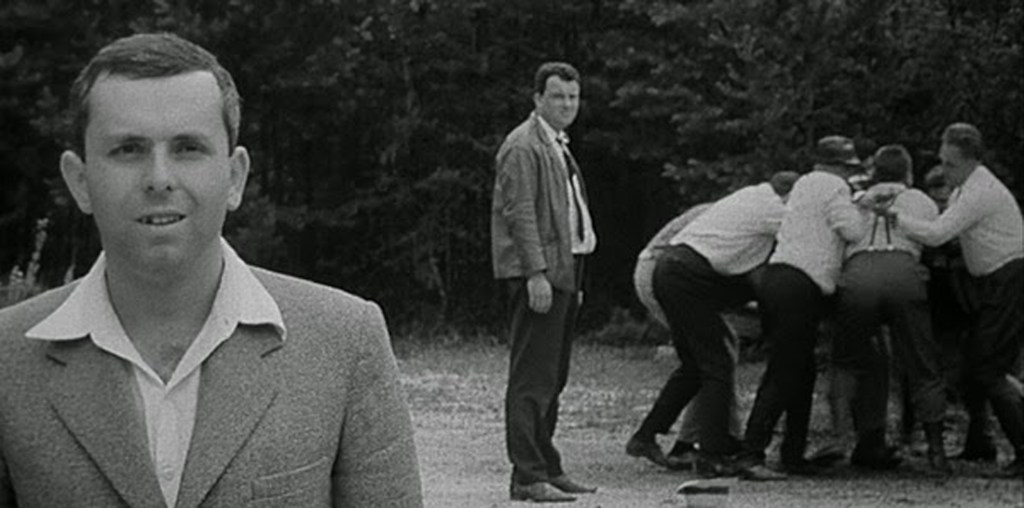
Guests at a large banquet in the forest toast the viewer in Jan Nemec's A Report on the Party and the Guests

Political satire can take many forms, but sometimes all that’s required is some actors, a few tables and chairs, and a patch of woodland. That’s all Jan Němec needed for A Report on the Party and the Guests, his abstract but high impact critique of life under communist rule in Czechoslovakia. It was considered scathing enough that it allegedly had Antonín Novotný, the president at the time, climbing the walls.

The concept of A Report on the Party and the Guests is about as simple as it gets. A group of middle-aged, middle-class lovers are having a picnic in a peaceful glade on a hot summer’s day. There is plenty of food and drink to go around, the weather is warm, and the friends are enjoying each other’s company. After freshening up in a babbling brook, the group are accosted by a shady little man in squeaky shoes – we later find out his name is Rudolf (Jan Klusák) – and his thuggish-looking cohorts.

Rudolf and his gang bundle the picnickers away to a clearing where he subjects them to an impromptu interrogation. The group are separated into men and women and locked up in an imaginary prison marked by a line drawn in the dirt, with two rocks representing a door.

The picnickers uneasily play along with Rudolf’s game for a while, with Josef (Jiří Němec) acting as their spokesperson. Conversely, Karel (Karel Mareš) gets fed up and grumpily storms off, crossing the line of their prison. In response, Rudolf instructs his mob to chase after the escapee and torment him a bit.

Two men look directly at the camera as a scuffle unfolds in the background in A Report on the Party and the Guests

The game is interrupted by a suave older gent in a shining white jacket, known only as the Host (Ivan Vyskočil). He apologises for Rudolf’s actions and charms the group, especially the ladies, and invites them to his birthday banquet by the lake. The picnickers are quickly intermingled with the other guests when they are all assigned seating away from each other. Any complaints are forgotten with the plentiful food and drink on offer, and Josef is rewarded for his attempt to parley with a seat at the head table.

As the celebrations progress, it soon becomes apparent that one of the picnickers, a taciturn man who quietly refused to suck up to the Host previously, has discreetly left the party…

Continue reading “A Report on the Party and the Guests (O slavnosti a hostech) – Jan Němec, 1966”

The Good Soldier Švejk (Dobrý voják Švejk) – Karel Steklý, 1956

I once knew an indestructible drunk who had a natural talent for causing mischief, then watching the mayhem unfold with a look of cherubic innocence on his face. I shared a grotty Barrandov flat with him for a while. The place was pretty dismal so we spent most of our waking hours in the pub, where I often ended up scrambling to unravel his mess while he sat there with his eyes spinning in opposite directions, chuckling to himself.

It was around this time that I first tried reading The Good Soldier Švejk. There was a remarkable facial similarity between my chaotic flatmate and the novel’s author, Jaroslav Hašek, himself a noted pub denizen, who in turn looked a little like the bottle-nosed character in Josef Lada’s famous illustrations from the book. Over time I conflated the three, so now years later I feel like I once lived with the good soldier himself.

Buy your copy of The Good Soldier Svejk from Amazon HERE

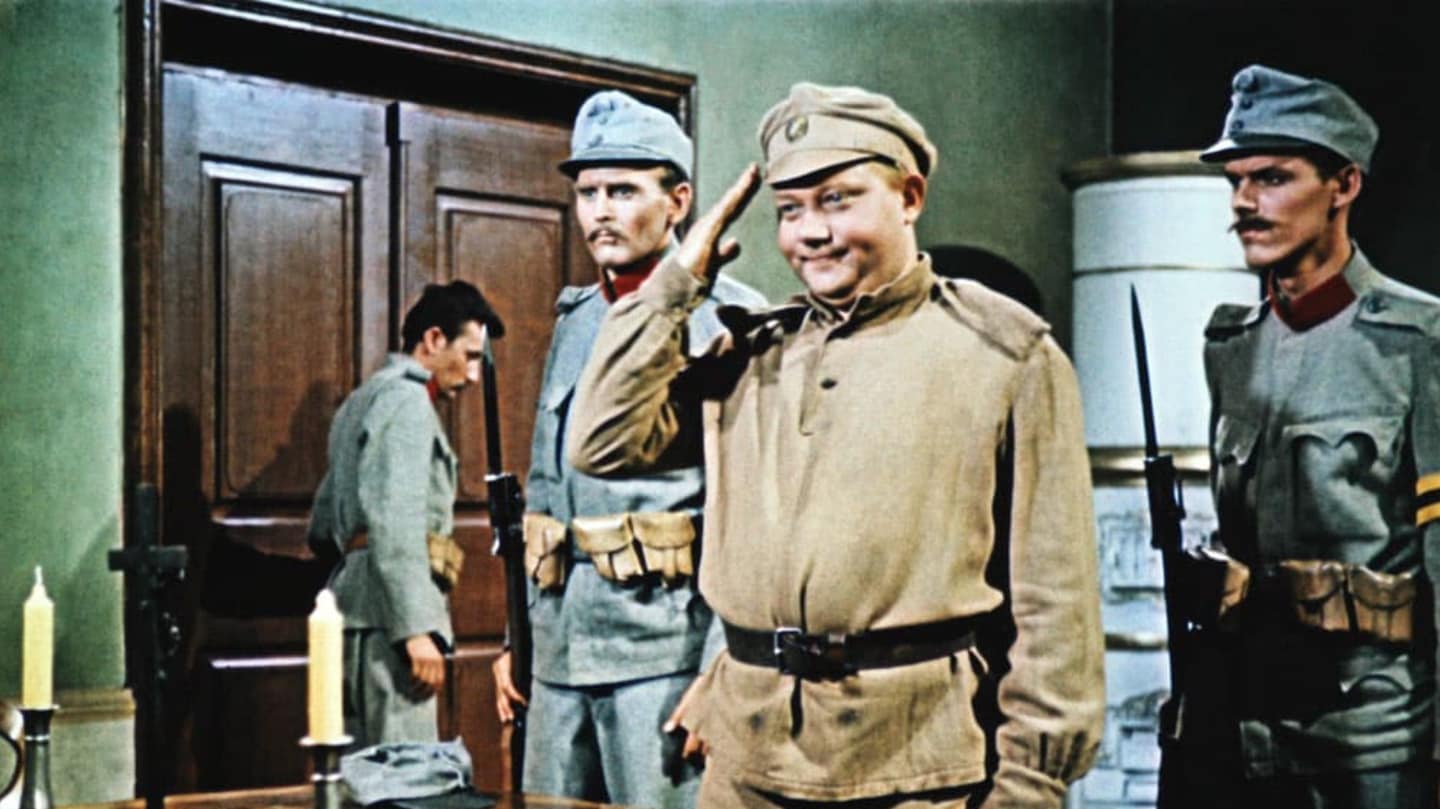
It has taken me almost one hundred posts on Czech Film Review to pluck up the courage to write something about Karel Steklý’s 1956 adaptation, perhaps the most well-known film version of the novel. It’s a daunting task – Švejk is a cultural icon in his home country and one of the most successful Czech exports, with Hašek’s novel translated into over 50 languages. There are dozens -if not hundreds – of beer halls and restaurants across the country bearing his name, and his image is common from the gift shops of Prague to the farmer’s pub in the small Moravian village where I recently moved. The word “Švejk” has also become a catch-all for willfully incompetent, subversive behaviour, commonly linked with the type of passive resistance that the Czechs have relied on to endure the numerous wars and foreign occupations of the last few centuries…

Continue reading “The Good Soldier Švejk (Dobrý voják Švejk) – Karel Steklý, 1956”