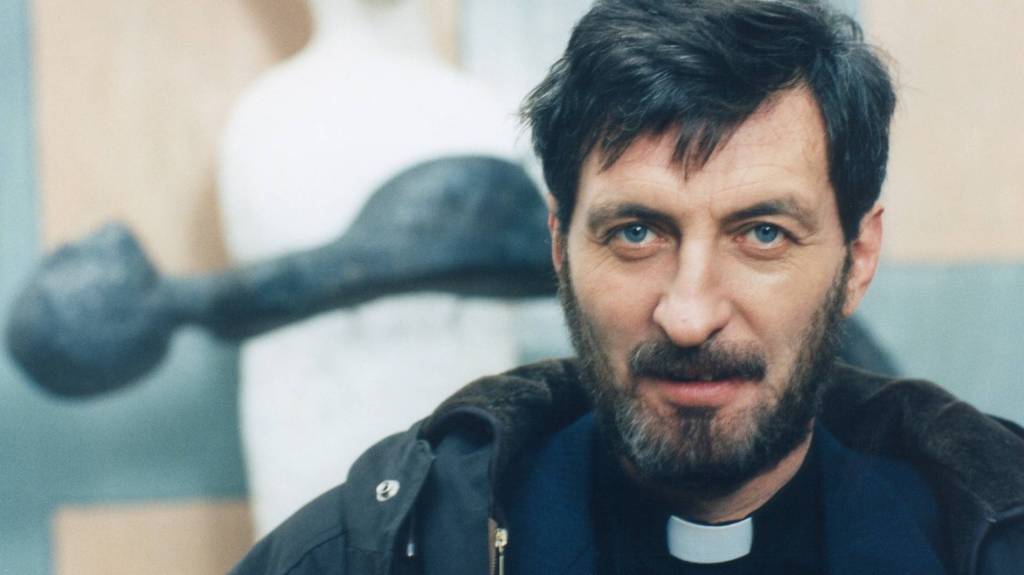
Father Holý (Bolek Polívka) is a modern village priest with a common touch, able to entertain his dwindling flock by framing his sermons as dreams he once had. In one of them, he relates the novel idea of walking into an abandoned church and finding God praying to humankind, desperate for proof of our continued existence.
This tale is a key moment in Forgotten Light, for while the film is ostensibly about a Catholic priest facing a crisis of faith at the butt end of the Communist regime in Czechoslovakia, it is ultimately more concerned with people’s ability to endure and maintain hope in Godless times.
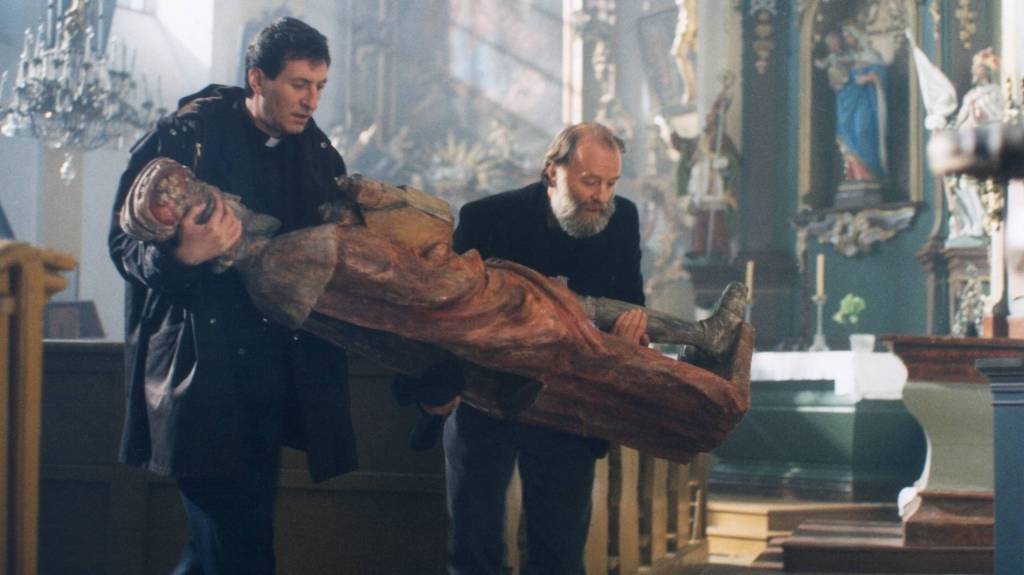
Holý is a Regular Joe sort of priest, just as adept at fixing a motor as he is delivering Mass, and able to match the denizens of the village boozer shot for shot. His backstory suggests that he joined the priesthood for an easier life rather than a burning sense of piety, and he clearly still has a discreet eye for the ladies. He now has quite a lot of time on his hands – his parish once had three churches, but two have been shuttered by the state and converted into storage facilities. His last remaining place of worship is in a severe state of neglect, but he keeps on keeping on through a sense of duty to his small community.
When the church springs a disastrous leak, Father Holý seeks funds to mend the roof. The atheistic Party is quite happy to let religion burn itself out through lack of funds and state support, however, and the seedy purse-keepers insinuate that he could get himself in a lot of trouble if he keeps pushing.
Holý’s a resourceful guy and hatches a risky scheme to raise the money himself, enlisting local sculptor Klima (Jiří Pecha) to carve a duplicate statue of St. Henry so he can flog the original to a wealthy foreign collector of religious artwork. Meanwhile, the priest also becomes involved in the plight of Marjánka (Veronika Žilková), a terminally ill woman he has long held a candle for.
We’re all familiar with the adage that war makes monsters out of men, and we’ve had numerous gruelling cinematic epics like Apocalypse Now and Come and See to hammer that point home. Before both those towering achievements, however, Czechoslovak New Wave director Karel Kachyňa succinctly showed that women are not exempt in his gripping drama Coach to Vienna.
Filmed during a period when the leading lights of the New Wave were largely focusing their talents on critiquing the Communist regime, Kachyňa’s film touches upon a shameful aspect of Czech history that came before. Much like František Vláčil’s sombre masterpiece Adelheid (1970), we’re dropped into the chaos and violence that accompanied the liberation of Czechoslovakia at the end of World War II, and the film nods toward the expulsion, mistreatment, and execution of ethnic Germans in the immediate aftermath.
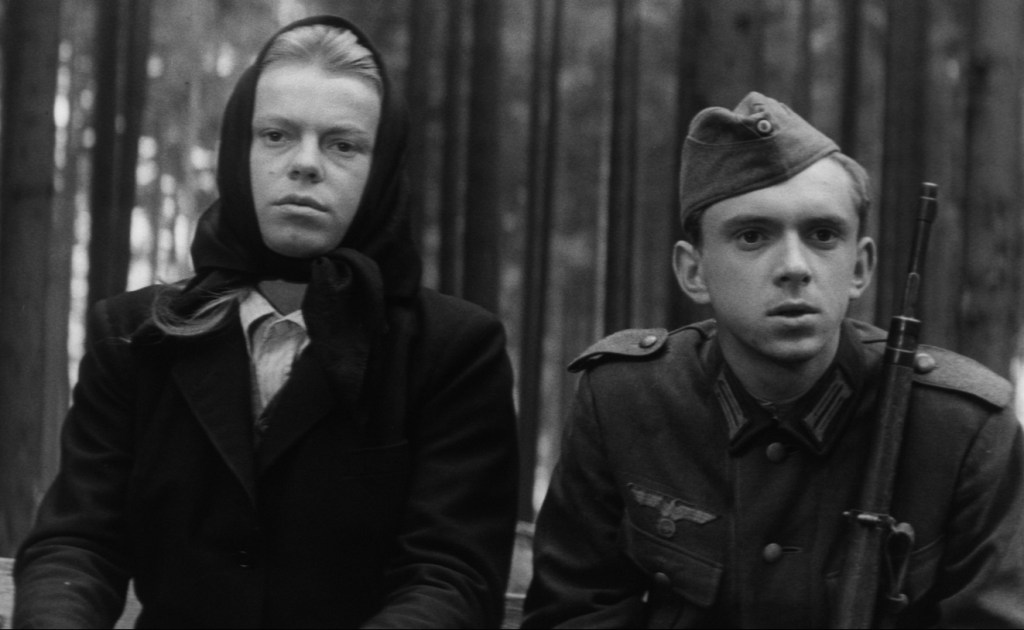
An opening title card sets up the story: Retreating German forces have executed a farmer for a petty offence, and his widow, Krista (Iva Janžurová), is forced at gunpoint to transport two deserting soldiers by horse and cart to safety across the border in Austria. Her passengers are mortally wounded Günther (Luděk Munzar) and his callow young comrade Hans (Jaromír Hanzlík). Taking the rutted tracks through misty forests haunted by Czech partisans, it is a slow ride to sanctuary – and Krista has only revenge on her mind…
I’ve only just revived this blog after an almost five-year absence, so it’s fair to say that I’m a little out of touch when it comes to more recent Czech cinema. So I did a search on IMDb, and what’s this wedged between two stone-cold classics in any language, Valerie and Her Week of Wonders and The Cremator? Tomasz Wiński’s erotic drama Borders of Love.
It certainly looks pretty racy from the poster, which depicts the lead actress Hana Vagnerová (Bikers) naked in the throes of ecstasy as she apparently takes on three guys. But those hairy-palmed viewers out there should put down the box of Kleenex, because that poster art is about as raunchy as it gets.
Instead, we get a rather dry Czech blend of Steven Soderbergh’s Sex, Lies, and Videotape and Lars von Trier’s Nymphomaniac, but one that is neither as perceptive as the former nor as in-your-face provocative as the latter.
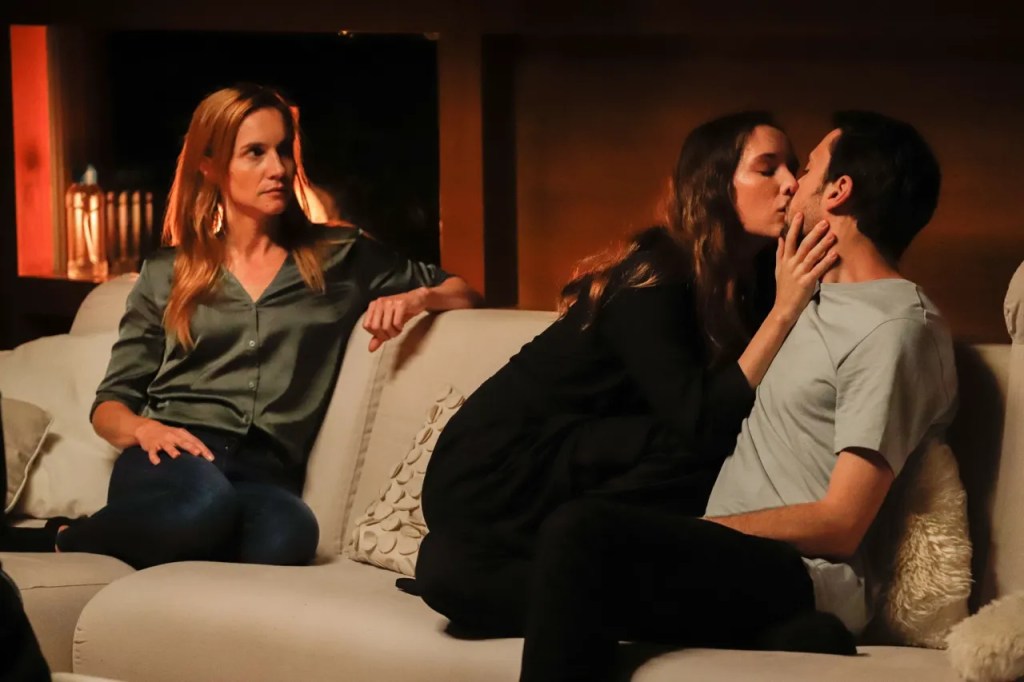
We meet Hana (Vagnerová) and Petr (Matyáš Řezníček), a photogenic, progressive, and sexually active Prague couple who start delving into each other’s fantasies during pillow talk. They get onto the subject of sleeping with other partners, and Petr is far more enthusiastic about the idea at first. However, when they begin experimenting with swinging friends and casual hook-ups, Hana starts enjoying herself far more than Petr’s fragile ego can handle, with predictably fraught consequences for their relationship…
Streamlined from Milan Kundera’s novel of the same name into a trim 81-minute film, Jaromil Jireš’s The Joke is nevertheless one of the most forthright condemnations of Communism to emerge from the Czechoslovak New Wave. As a result, it was banned by the authorities shortly after its original run in 1969 and didn’t see the inside of a cinema again for another two decades.
Frankly, it’s remarkable that the film received a theatrical release at all. Unlike some other celebrated works of the period that took issue with the regime, The Joke doesn’t distance itself through allegory (such as Miloš Forman’s The Firemen’s Ball) or surrealism (Věra Chytilová’s Daisies). Those movies were censored, too, but Jireš’s quiet yet powerful adaptation of Kundera’s book comes right out and says it: People who didn’t toe the line (either wilfully or by misfortune) routinely had their lives shattered by the authorities.
The film opens as our cynical protagonist, Ludvik Jahn (Josef Somr), a middle-aged scientist and self-confessed womaniser, returns to his hometown in Moravia after a long absence. He meets Helena (Jana Dítětová), a reporter who wants to interview him for an article. By coincidence, she happens to be married to Pavel Zemánek (Luděk Munzar), a man Ludvik went to college with in Prague many years before. With this newfound knowledge, Ludvik decides he will seduce Helena to cuckold his old school chum and get belated revenge.
After parodying old-fashioned Hollywood cowboy movies in Lemonade Joe, the Czech Mel Brooks returned to affectionately lampooning American genres with Four Murders Are Enough, Darling. This time, classic crime flicks and pulp fiction are the targets, and Oldřich Lipský apparently never encountered a gag that he didn’t deem worthy for inclusion in his movies. I say that in the best possible sense – here, the sheer deluge of broad jokes, irreverent wordplay, comic misunderstandings, and slapstick humour has a cumulative effect, rolled into a madcap farce with the purest intention: To make the audience laugh as often as possible.
Whether all the hilarity fully translates if you don’t speak Czech is another matter, but you’ll get the general vibe. The movie starts fast and sets the tone with a jaunty title sequence with evocatively dynamic comic book art by Kája Saudek. Then we’re on a night train where Dr. James Porter (Viktor Maurer), is nervously transporting a million-dollar cheque from Michago to San Fernando. Unfortunately for them, rival gangs from each city are also onboard with murderous designs on the loot.
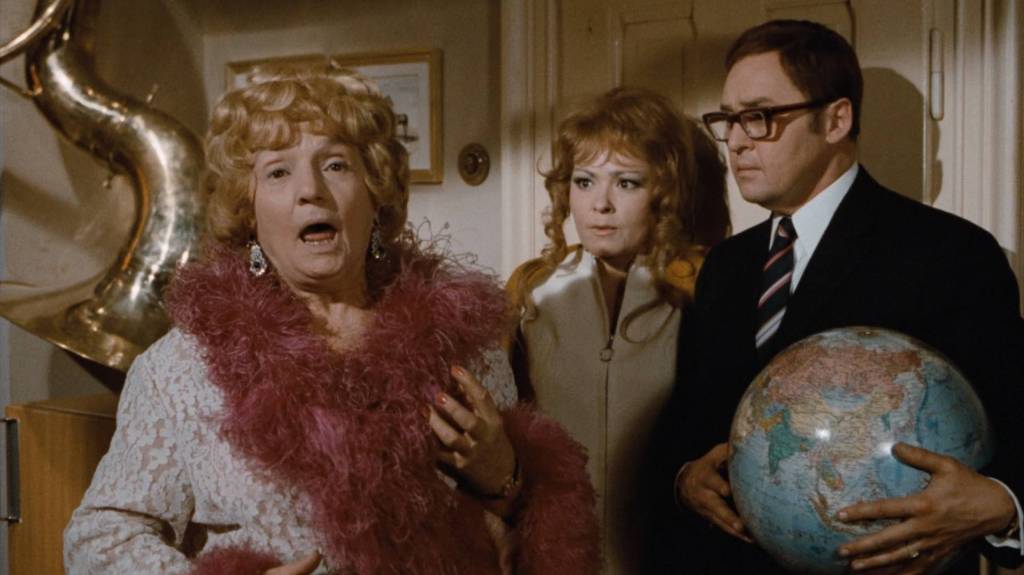
Segue to Springtown, where Lipský’s brother Lubomír (a regular actor in the director’s films) plays George Camel, a straight-laced school teacher with lofty literary ideals who doesn’t get much respect from his class – the kids would rather read comic books than Macbeth. He lives a solitary bachelor’s existence in a boarding house where he plays tuba and constantly gets nagged by his landlady, and tries to sell his highfalutin poetry to the local tabloid.
This is where he catches the eye of bored reporter Sabrina (Jiřina Bohdalová), who decides to woo George to make her roguish illustrator boyfriend jealous. George is excitedly getting ready for his hot date with her when the recently deceased Dr. Porter appears on his doorstep. Rather than call the police, however, George hastily stashes the stiff before Sabrina arrives.
Things escalate quickly as both gangs descend on the boarding house and take rooms, bumping each other off as they try to shake down George for the missing cheque. Already suspected of one murder by the bumbling cops, George arouses further suspicion when another dead body falls into his arms every time he opens a door. Initially setting out to clear his name by trying to find out who poisoned Dr. Porter, George grows to enjoy the notoriety as a feared killer and the increasingly amorous advances of Sabrina…
When I first visited Prague at the tail end of the ’90s, I was captivated by the city to the extent that it dominated my every waking thought. Like for millions of tourists each year, it was the historic centre’s visual splendour that first set my heart racing, but it wasn’t long before I got to know the less postcard-friendly side as well.
Attending a teaching course in the freezing winter of early 2002, the school provided cheap digs in a Communist-era Panelák out in the Barrandov district – namely, a block of flats constructed from panels of prefabricated concrete. In truth, it didn’t look all that different from similar eyesores in Britain, but it was still a striking contrast to the “Golden City” image of Prague. Just as the towers, domes, and spires of the centrum appeared etched in crystal thanks to the crisp, cold January air, the stark right angles and brute bulk of the housing project were brought into sharp focus in the snow and ice.
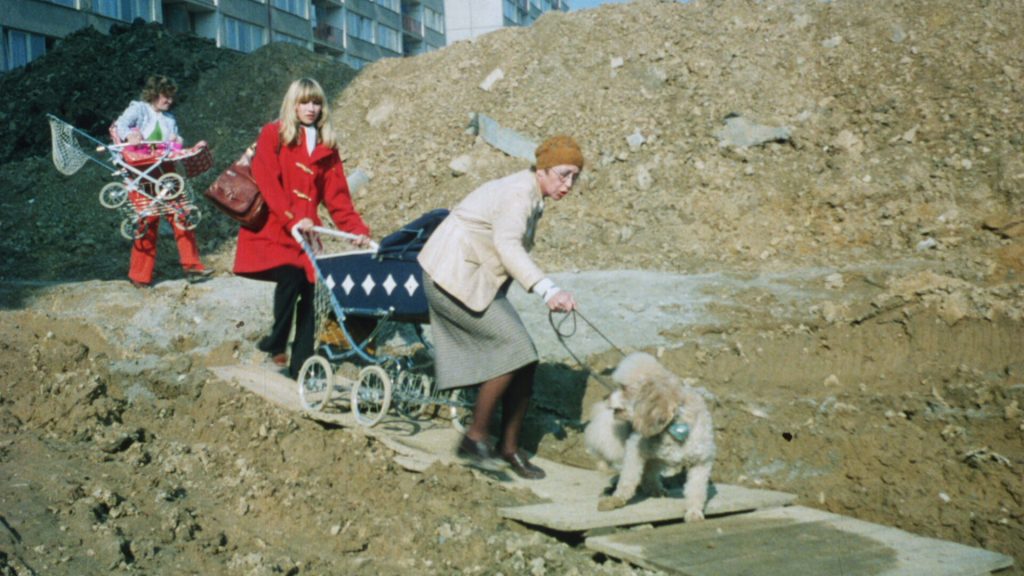
There was heavy construction going on at the time, which meant a lot of rubble and heaps of earth for the locals to pick their way through as they went about their daily business. One night, my flatmate was staggering back from the pub when he fell into an open trench and lay unconscious as the falling snow began covering him up. Luckily, a passing group of teenagers spotted him, fished him out, and took him back to the pub for a few reviving rounds of beer and shots.
I was reminded of this incident continually while watching Prefab Story, Věra Chytilová’s tragicomic day-in-the-life of the vast Jižní Město housing estate in Prague. The narrative, such as it is, follows an elderly man who arrives from the countryside to live with his daughter in one of the concrete monstrosities, but neither the taxi driver nor the harried locals can pinpoint the correct tower block…
As Ronan Keating, that perennial purveyor of pop pap, once sang: “Life is a rollercoaster, just gotta ride it” – that’s the happy-go-lucky ethos of Men in Hope‘s Rudolf (Bolek Polívka), an ageing lothario and Prague cabbie with 138 extra-marital affairs under his belt. He previously had a very movie-land former career as an international rollercoaster designer, providing him ample opportunity to cheat on his wife, and gives us a handy metaphor for his attitude towards relationships. As a man who spent his life building fairground thrill rides, he knows all about the twists, turns, ups, downs and loop-the-loops that only an adulterous lifestyle can offer.
Rudolf reasons that a well-timed affair can save a relationship. He prides himself on never getting caught in over 35 years of marriage to his wife, Marta (Simona Stašová), and she benefits too. Having a series of flings with much younger women gives him a little extra energy when it’s time to perform his husbandly duties at home.
This philosophy is met with mild disapproval by Ondřej (Jiří Macháček), Rudolf’s downcast, browbeaten son-in-law, a former accountant who runs a failing restaurant with his frosty wife Alice (Petra Hřebíčková). Their marriage is stuck in a loveless rut, but Alice wants another baby and times their intimate moments accordingly. This puts pressure on Ondřej to come up with the goods as he worries about his fertility.
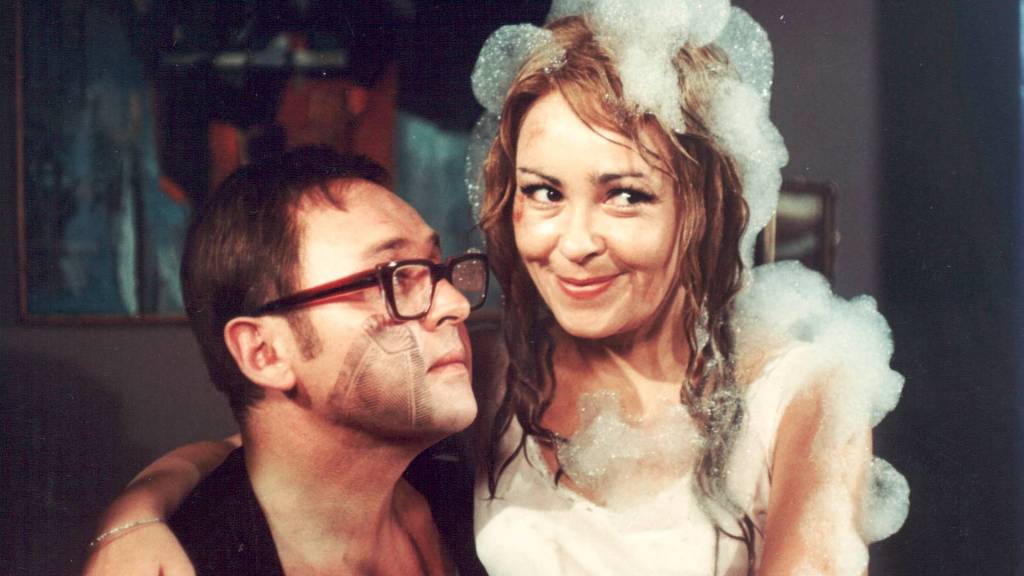
Things change when Ondřej meets Rudolf’s latest date, Šarlota (Vica Kerekes), a curvy red-headed bombshell who has been doing community service as penitence for dancing naked in a fountain. She has a special way of putting a smile on a guy’s face, and despite his misgivings, Ondřej can’t help but brighten up in her presence.
Before we know it, Šarlota tracks Ondřej down to his customer-free restaurant and starts an affair with him. Cheating on his wife peps Ondra up – he suddenly starts taking pride in his business, showing a little flair in the kitchen, as well as finding a bit more va-va-voom in the bedroom. Rudolf’s philosophy seems to be paying dividends when a sudden tragic event changes his point of view…
Once on a family holiday, we were walking around the side streets of a small Welsh town when we stumbled upon an old bric-a-brac shop that was closed for many years. Among the dusty collection of forlorn objects in the window display sat a vintage doll with braided hair, a straw hat, and a yellowed cotton dress. Her cheeks were webbed with tiny cracks and one of her eyes was missing. With her remaining eye, she gazed out across the universe like a martyr in a medieval painting. A huge dead spider lay curled up in her lap.
That image really troubled my childhood imagination, filled me with a terrible sense of nausea. It is the same feeling I got years later when I first saw Jan Švankmajer’s Jabberwocky, which is celebrating its 50th anniversary this year. His use of musty found objects in his animation, including dolls like the one sitting in that shop window years ago, disturbs me to this day.
Strangely I consider this a good thing, and with this in mind, I thought I’d check out Švankmajer’s final film, Insects. The blurb states that it is based on the play Pictures from the Insects’ Life by Karel and Josef Čapek, although that is a little misleading. The film finds Švankmajer in a playful mood, seemingly determined to do everything apart from shoot a straightforward adaptation of the satirical work.
After a cold open where we see a middle-aged man dressed in bug wings and goggles hurrying along the street, Švankmajer appears before the camera himself to provide a foreword for his new feature. The brothers Čapek wrote the play in 1924 while Hitler was sitting in a pub scheming his terrible schemes and Lenin was building his first gulags. Meanwhile, the Czechs and Slovaks were enjoying their newly founded republic, and people found the Čapek’s play a bit too pessimistic for the times. It was sheer youthful misanthropy, he tells us, and only gained greater relevance as the momentous events of the 20th century unfolded.
All very interesting, you might think, and this foreword certainly whetted my appetite for the adaptation that was to follow. However, that is when Švankmajer goes deliberately off-script, flunking his lines and warning us of the chaos to follow…
I’ve reviewed quite a few older classics recently, so this week I decided to play Random Czech Movie Roulette with some of the newer content on Netflix. I landed on Milan Cieslar’s “romantic comedy” Špindl…
Oh dear.
Well, I said from the beginning that my blog would cover all Czech movies, including the bad ones, so here goes…
Anna Polívková stars as Katka, a sad sack singleton in her mid-thirties (something of a recurring role for her) who hates her job and dreams of one day finding Mr Right. I feel a bit sorry for Polívková. Firstly, she is following in the footsteps of her father, Bolek Polívka, one of the greatest living Czech actors. Secondly, she keeps finding herself in lame sex comedies like Špindl and Holiday Makers, or playing second banana to her illustrious dad in terrible sequels like The Inheritance 2. I’m still getting over the scene in Holiday Makers where she lets a 13-year-old boy grope her breasts to help “cure” him of his suspected homosexuality.
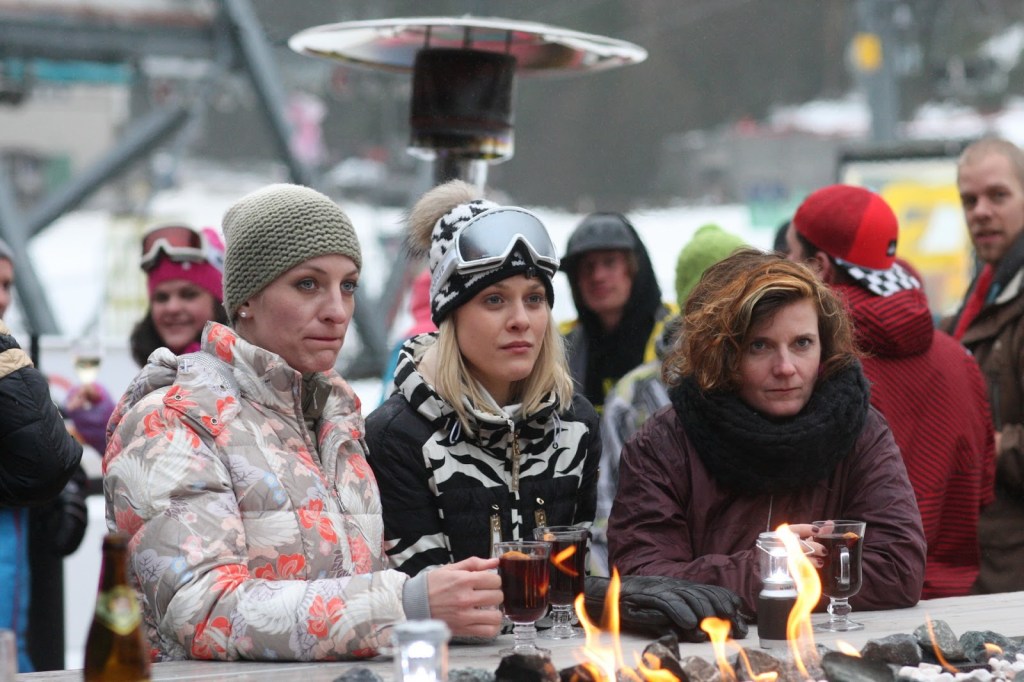
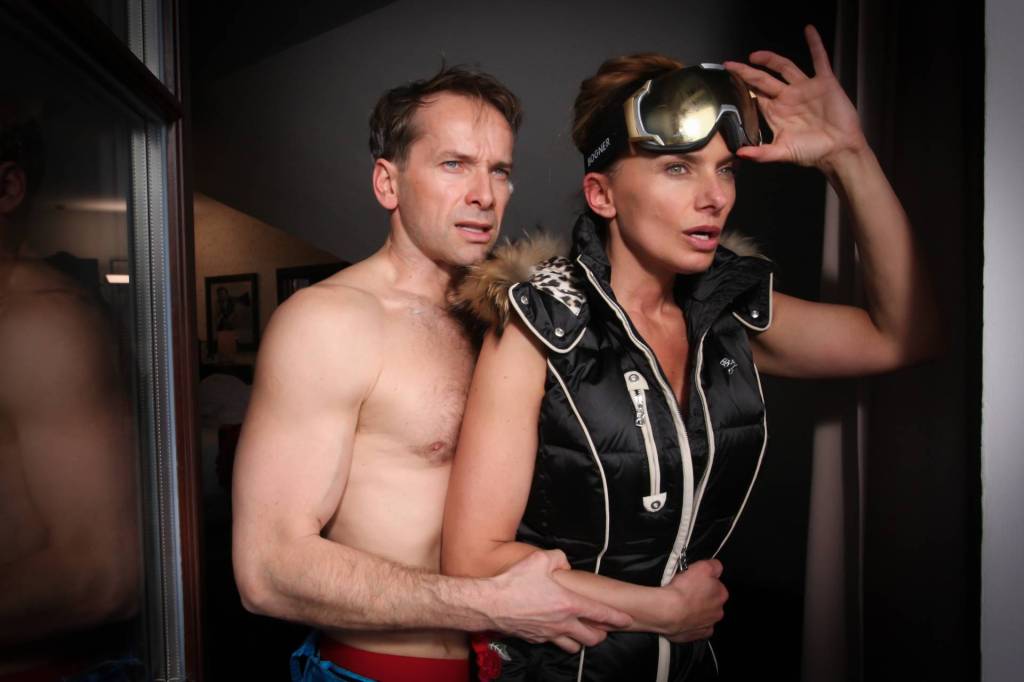
Anyway, Katka is down in the dumps and sharing her woes with her two sisters – worldly, tattooed artist Magda (Anita Krausová) and happy-go-lucky model Eliška (Kateřina Klausová). Eliška has a surprise to cheer her up. She has paid for three all-inclusive tickets to the mountain resort of Špindlerův Mlýn for a week of skiing, boozing and picking up guys. Who knows? Maybe one of them could be the Mr Right Katka is hoping for…
Also on his way to the mountains is Tonda (David Gránský), a young musician joining the resort’s resident band headed by Mrkvička, a slovenly middle-aged rocker played by Jakub Kohák, the Czech Republic’s hairiest living celebrity. Tonda hopes that the rock ‘n’ roll lifestyle will improve his chances with the ladies, and his new bandmates are all too happy to help out.
On arrival in the resort, the girls meet Lukáš (Roman Blumaier), supposedly the hotel owner whose welcoming spiel announces “Americans have Las Vegas; Czechs have Špindl” – promising a week of fun and frolics that they won’t need to take home with them unless they really want to. Straight away, things take a turn for the worst. The swanky ski lodge Eliška reserved has double-booked, so they have to stay at the shabby Three Mountains hotel nearby instead.
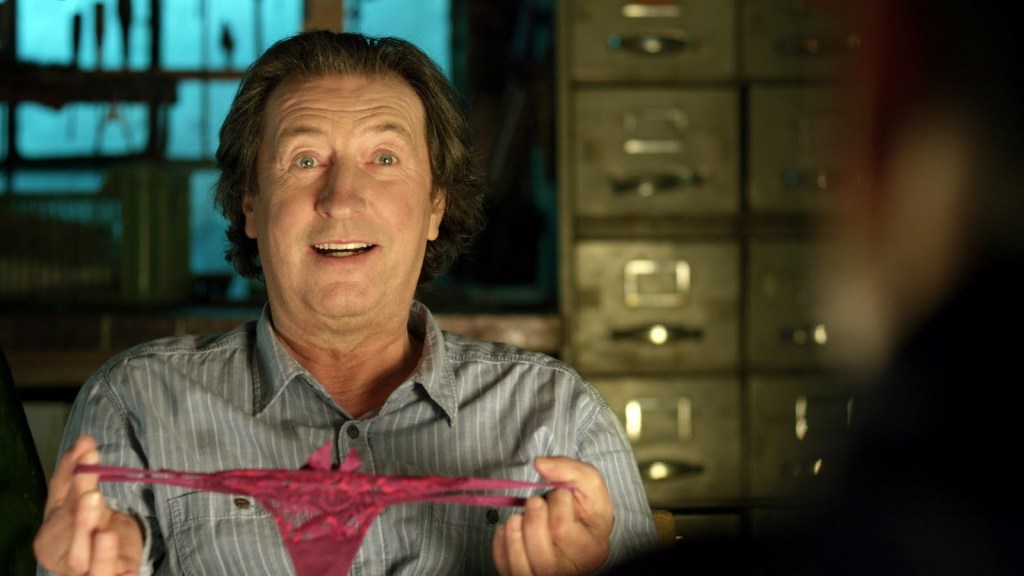
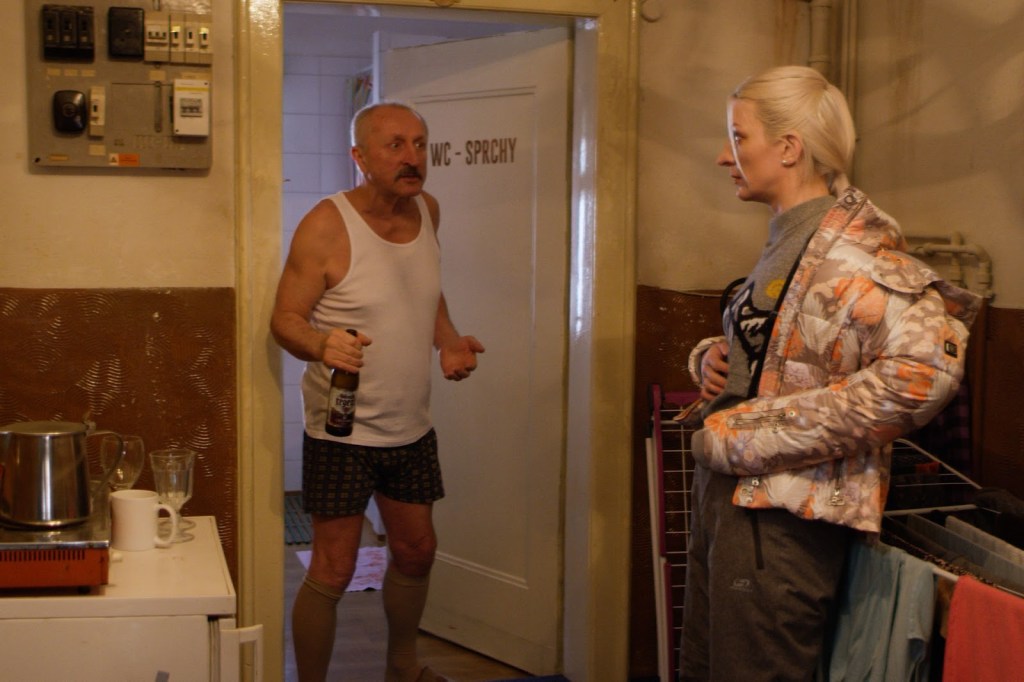
It’s a creaky old place with peeling wallpaper, paper-thin walls and nudie photos on the shared bathroom wall. Despite the setback, they decide to make a go of it and find that they must share the lodgings with the cheerfully inappropriate older couple in the next room and Tonda’s raucous band.
The next hour creeps by with a mixture of pitiful slapstick (Katka has about 700 skiing accidents), awkward gross-out humour (Eliška walks in on an old man masturbating to some vintage porn) and cringe-inducing sexual liaisons (Katka’s ill-advised date with slimy Lukáš had me watching through my fingers like it was a horror movie).
It’s all so painfully weak. It makes the unholy trinity of Michal Viewegh adaptations – Holiday Makers, From Subway with Love, and Angels of Everyday – seem like comedy classics in comparison. At least those movies had a little energy and were strangely entertaining despite their crass sexual politics. Špindl starts weak, with Polívková’s half-hearted Bridget Jones-style voice-over and Chinaski’s weak pop-rock tunes on the soundtrack, and gets progressively weaker as it goes along.
To make matters worse, it is also one of those films that thinks it’s clever by making copious references to much better movies. It has the unfortunate effect of making you wish you were watching those movies instead. Marek Vašut pops up for a scene to quote his sleazy role in From Subway with Love. The cutesy earworm “Sladké mámení” from the snowbound family classic I Enjoy the World with You gets two renditions in the space of five minutes. Later, we get a bizarre Jurassic Park reference when Tonda is chased through a hotel kitchen by a sexually frustrated older woman.
More depressing still is the film’s attitude towards sexual relationships. Like those Viewegh movies, neither sex comes off well. Špindl depicts blokes as scoundrels and cheats who are only after one thing, modern cavemen who can’t make it through five minutes without crudely hitting on a member of the opposite sex. The women are always desperate singles whose brains can’t function properly without a man’s attention, and are willing to sink to their level in the dwindling hope of finding “Mr Right”. When Mr Right finally shows up for Katka, the romantic element comes as an afterthought, in the mid-credit scenes, just before a short skit where a man sprinkles his crab-infested pubes on another guy’s head (spoiler alert). It’s all so tawdry and cynical.
The film’s saving grace is the three performances by Polívková, Krausová and Klausová, who gamely struggle with the unfunny material and somehow emerge with a little dignity intact. Polívková seems like she could be good with a decent script, but so far, I’ve only seen her in terrible movies. I can’t figure out whether she is a genuinely sympathetic screen presence or a screen presence in need of genuine sympathy.
I usually avoid saying people shouldn’t watch a movie because everyone should make up their own minds. Yet Špindl is a romantic comedy so totally lacking both romance and laughs, leaving you with a big empty nihilistic void of a movie. So I’ll conclude by saying this: watch it if you want, but it might put you off sex, skiing and human interactions for a few months at least.
Sometimes a film just doesn’t grab me at all and then I’m sat looking at a blank document thinking, “I don’t know if I can be bothered to write anything about this”. It is extra frustrating when I can see the film’s qualities, but feel so neutral towards it that I struggle to muster any enthusiasm.
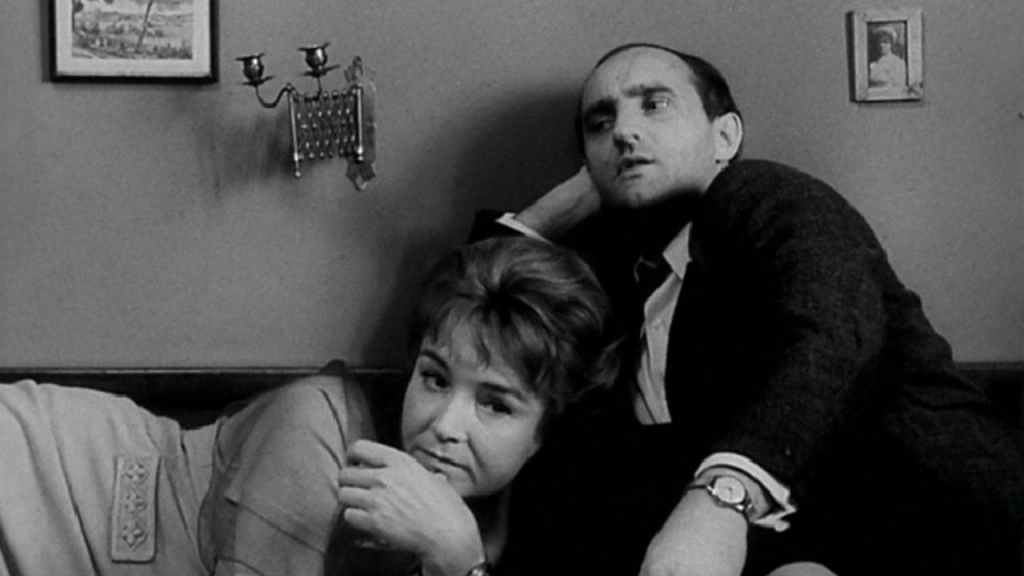
One such film is Juráček & Schmidt’s Joseph Kilian, a paranoid short drama from the Czechoslovak New Wave. Knowing that the review is going to be a battle, I face a dilemma. Do I –
a) Give up on the movie and watch something else, then maybe come back another time when a change of mood or circumstances might make it chime differently.
b) Plough ahead regardless and eke out 700-800 words on it, going through the motions and stating the obvious, like the clear influence of Franz Kafka and blah blah blah.
Or
c) Find a hook, a way to approach the film that will entertain me and, in turn, hopefully make the article more entertaining for the reader. My first instinct with Joseph Kilian is to go with option C, but what is the hook?

 Sometimes a film just doesn’t grab me at all and then I’m sat looking at a blank document thinking, “I don’t know if I can be bothered to write anything about this”. It is extra frustrating when I can see the film’s qualities, but feel so neutral towards it that I struggle to muster any enthusiasm.
 Czech Film Review