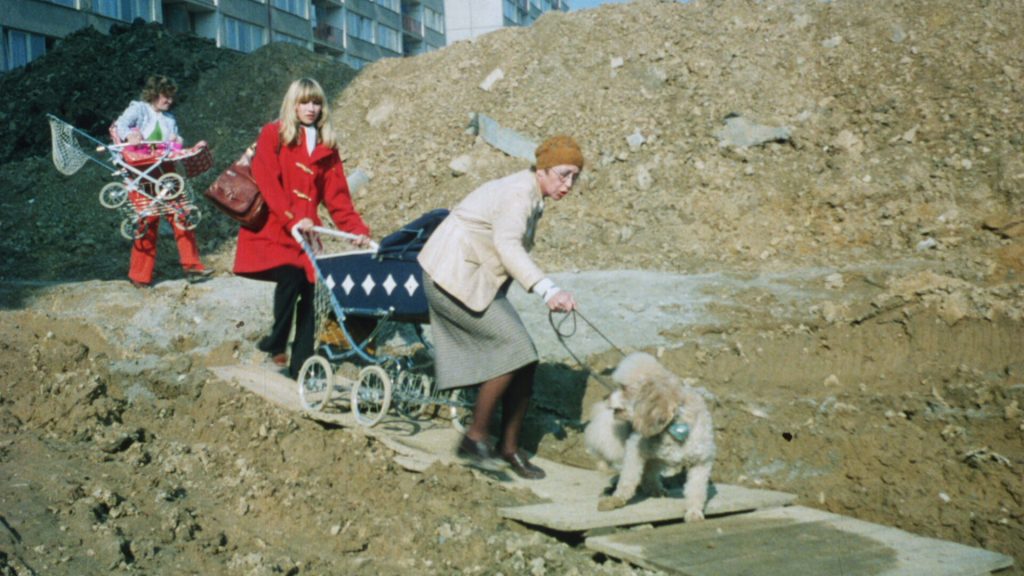
Prefab Story (Panelstory aneb Jak se rodí sídliště) – Věra Chytilová, 1979

Residents struggle through the rubble in Prefab Story

When I first visited Prague at the tail end of the ’90s, I was captivated by the city to the extent that it dominated my every waking thought. Like for millions of tourists each year, it was the historic centre’s visual splendour that first set my heart racing, but it wasn’t long before I got to know the less postcard-friendly side as well.

Attending a teaching course in the freezing winter of early 2002, the school provided cheap digs in a Communist-era Panelák out in the Barrandov district – namely, a block of flats constructed from panels of prefabricated concrete. In truth, it didn’t look all that different from similar eyesores in Britain, but it was still a striking contrast to the “Golden City” image of Prague. Just as the towers, domes, and spires of the centrum appeared etched in crystal thanks to the crisp, cold January air, the stark right angles and brute bulk of the housing project were brought into sharp focus in the snow and ice.

There was heavy construction going on at the time, which meant a lot of rubble and heaps of earth for the locals to pick their way through as they went about their daily business. One night, my flatmate was staggering back from the pub when he fell into an open trench and lay unconscious as the falling snow began covering him up. Luckily, a passing group of teenagers spotted him, fished him out, and took him back to the pub for a few reviving rounds of beer and shots.

I was reminded of this incident continually while watching Prefab Story, Věra Chytilová’s tragicomic day-in-the-life of the vast Jižní Město housing estate in Prague. The narrative, such as it is, follows an elderly man who arrives from the countryside to live with his daughter in one of the concrete monstrosities, but neither the taxi driver nor the harried locals can pinpoint the correct tower block…

Continue reading “Prefab Story (Panelstory aneb Jak se rodí sídliště) – Věra Chytilová, 1979”

Insect (Hmyz) – Jan Švankmajer, 2018

A menacing man holding a knife and wearing a balaclava with comic bug antennae in Jan Svankmajer's Hmyz

Once on a family holiday, we were walking around the side streets of a small Welsh town when we stumbled upon an old bric-a-brac shop that was closed for many years. Among the dusty collection of forlorn objects in the window display sat a vintage doll with braided hair, a straw hat, and a yellowed cotton dress. Her cheeks were webbed with tiny cracks and one of her eyes was missing. With her remaining eye, she gazed out across the universe like a martyr in a medieval painting. A huge dead spider lay curled up in her lap.

That image really troubled my childhood imagination, filled me with a terrible sense of nausea. It is the same feeling I got years later when I first saw Jan Švankmajer’s Jabberwocky, which is celebrating its 50th anniversary this year. His use of musty found objects in his animation, including dolls like the one sitting in that shop window years ago, disturbs me to this day.

Strangely I consider this a good thing, and with this in mind, I thought I’d check out Švankmajer’s final film, Insects. The blurb states that it is based on the play Pictures from the Insects’ Life by Karel and Josef Čapek, although that is a little misleading. The film finds Švankmajer in a playful mood, seemingly determined to do everything apart from shoot a straightforward adaptation of the satirical work.

After a cold open where we see a middle-aged man dressed in bug wings and goggles hurrying along the street, Švankmajer appears before the camera himself to provide a foreword for his new feature. The brothers Čapek wrote the play in 1924 while Hitler was sitting in a pub scheming his terrible schemes and Lenin was building his first gulags. Meanwhile, the Czechs and Slovaks were enjoying their newly founded republic, and people found the Čapek’s play a bit too pessimistic for the times. It was sheer youthful misanthropy, he tells us, and only gained greater relevance as the momentous events of the 20th century unfolded. 

All very interesting, you might think, and this foreword certainly whetted my appetite for the adaptation that was to follow. However, that is when Švankmajer goes deliberately off-script, flunking his lines and warning us of the chaos to follow…

Continue reading “Insect (Hmyz) – Jan Švankmajer, 2018”

Indie Profiles: Nora Štrbová, director of S P A C E S (M E Z E R Y)

Nora Strbova

Of all the terrific entries on display recently at the 61st BRNO16 International Short Film Festival, Nora Štrbová’s S P A C E S was perhaps the most moving. In just seven minutes, the animated documentary explores memory from the perspective of her brother, who suffered a rare neurological disorder before his untimely death in his twenties. With a minimalist, hand-crafted style that evokes the glitching memory of its central character, S P A C E S is a poignant blend of artistic medium and heartfelt subject matter.

I spoke to Nora about S P A C E S and her experiences as a filmmaker with my friend Tomáš Hůsek, who helped translate the conversation…

LA & TH: This is clearly a labour of love about a very personal subject, as you directed, wrote, animated and created the art design for the film. What made you choose this style to tell the story?

NS: Well, at the beginning when I was thinking about what the movie is going to be, the idea about the subject matter came to me. The entire style of the film is derived from that original concept. It is a very personal story about my brother who lost his memory because of the brain tumour that eventually caused his death. I wanted to try… after I was no longer able to ask him about it… try to imagine how he might perceive the world without memory, what does it mean to live without memory, and also think about what memory actually is.

I started reading articles, books, stories – both fiction and non-fiction – poetry, everything. From this, I put together a sort of mosaic and the style of the film, which is mosaic-like, actually reflects that. It felt fitting to choose a kaleidoscopic form to show how the human mind and memory works. The more I analysed how memory behaves, the more I found out that it is mostly fragments, even in healthy individuals. It is just fragments saved into memory. Sometimes just emotions or sensations that we once felt during situations rather than the situations themselves – colours, smells, textures etc. So I wanted to create that feeling for the viewer… Continue reading “Indie Profiles: Nora Štrbová, director of S P A C E S (M E Z E R Y)”

Indie Profiles: Valida Baba

Filmmaker Valida Baba
Photo credit: Jakub Hrab

Valida Baba is an Azeri filmmaker who has called Prague her home for the past eight years. She uses photography, poetry and dance in her short experimental films to explore her ideas about human relationships and existence. I spoke to her about her work, her influences and her experiences so far in the Czech capital.

Hey, so thanks for making time to speak with me! First off, can you tell me about your first impressions of Prague?

Well, when I was first accepted at FAMU to study photography, I didn’t even know that it was so famous for film and photo! But when I first arrived at the airport I got the feeling of coming home. Of course, Azerbaijan is my home too, but even when I travel abroad now I get the sense of coming home when I return to Prague, and it is such a deep feeling for me, you know?

How does Azerbaijan compare to the Czech Republic culturally?

They are not too similar culturally, because Azeri culture is more like Turkish. However, because we were also part of the Soviet Union we have Russian as a second language, so there are some Slavic influences there.

Prague has become almost synonymous with Hollywood blockbusters over the last few decades, but how does the city treat an indie filmmaker working on smaller projects?

When I was studying at FAMU I could see that there are lots of opportunities to make films here. However, there was always some divide between the Czech community and the foreign community, and I was so introverted to begin with that I found it hard to communicate. I love making films but it felt like there was a border I needed to cross before I could start working with people, which is why I originally did it independently. Then I realised that it’s hard to make a film by yourself, and much easier when you have a team of like-minded people all working towards one goal.

Generally, Czech people are open and willing to collaborate if you are willing to open up to them, so it was my problem to solve, how to be more outgoing with them. Now there are many female film producers coming through who are looking to work with female directors, so it’s easier to start working on a project and take it in the direction to want…

Continue reading “Indie Profiles: Valida Baba”