Forgotten Light (Zapomenuté světlo) – Vladimír Michálek, 1996

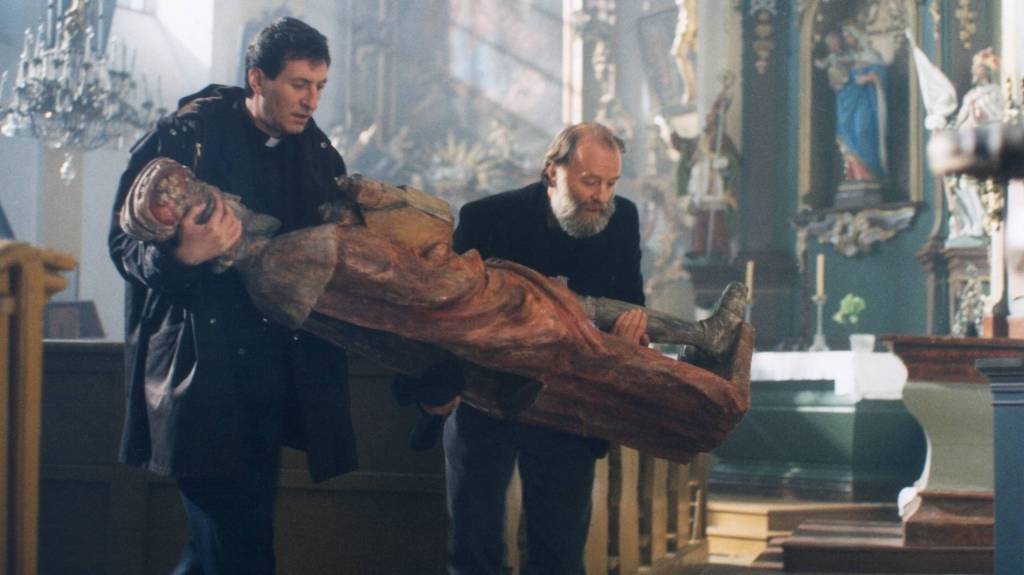
Father Holy and his sculptor friend carrying a religious statue in Forgotten Light

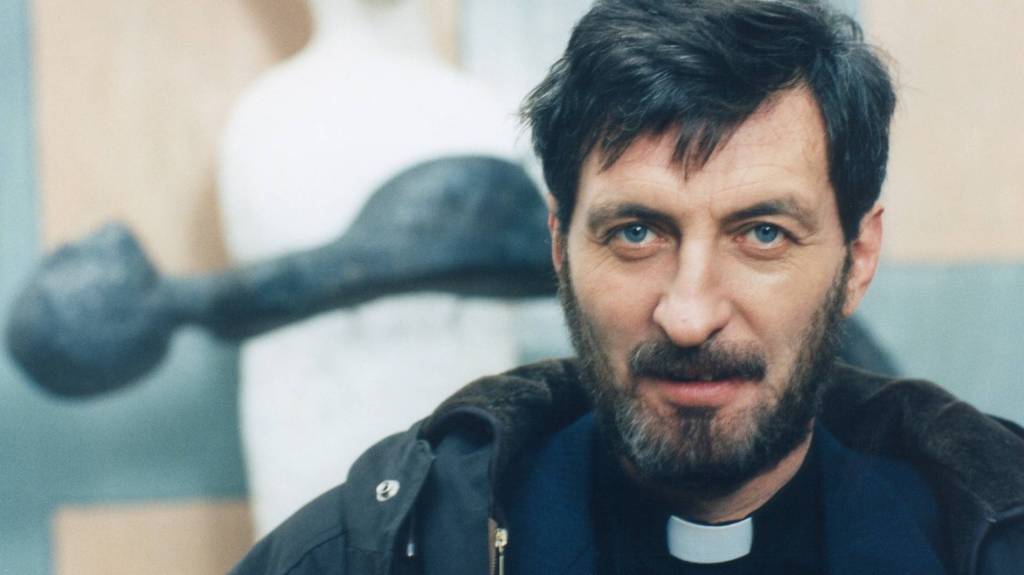
Father Holý (Bolek Polívka) is a modern village priest with a common touch, able to entertain his dwindling flock by framing his sermons as dreams he once had. In one of them, he relates the novel idea of walking into an abandoned church and finding God praying to humankind, desperate for proof of our continued existence.

This tale is a key moment in Forgotten Light, for while the film is ostensibly about a Catholic priest facing a crisis of faith at the butt end of the Communist regime in Czechoslovakia, it is ultimately more concerned with people’s ability to endure and maintain hope in Godless times.

Holý is a Regular Joe sort of priest, just as adept at fixing a motor as he is delivering Mass, and able to match the denizens of the village boozer shot for shot. His backstory suggests that he joined the priesthood for an easier life rather than a burning sense of piety, and he clearly still has a discreet eye for the ladies. He now has quite a lot of time on his hands – his parish once had three churches, but two have been shuttered by the state and converted into storage facilities. His last remaining place of worship is in a severe state of neglect, but he keeps on keeping on through a sense of duty to his small community.
Bolek Polívka as doubting priest Father Holy in Forgotten Light

When the church springs a disastrous leak, Father Holý seeks funds to mend the roof. The atheistic Party is quite happy to let religion burn itself out through lack of funds and state support, however, and the seedy purse-keepers insinuate that he could get himself in a lot of trouble if he keeps pushing.

Holý’s a resourceful guy and hatches a risky scheme to raise the money himself, enlisting local sculptor Klima (Jiří Pecha) to carve a duplicate statue of St. Henry so he can flog the original to a wealthy foreign collector of religious artwork. Meanwhile, the priest also becomes involved in the plight of Marjánka (Veronika Žilková), a terminally ill woman he has long held a candle for.

Continue reading “Forgotten Light (Zapomenuté světlo) – Vladimír Michálek, 1996”
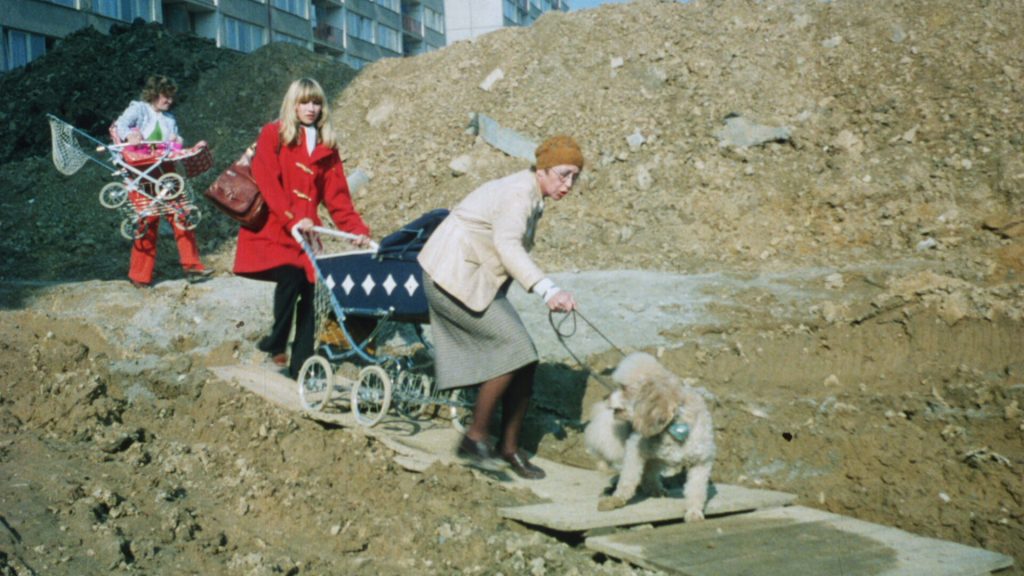
Prefab Story (Panelstory aneb Jak se rodí sídliště) – Věra Chytilová, 1979

Residents struggle through the rubble in Prefab Story

When I first visited Prague at the tail end of the ’90s, I was captivated by the city to the extent that it dominated my every waking thought. Like for millions of tourists each year, it was the historic centre’s visual splendour that first set my heart racing, but it wasn’t long before I got to know the less postcard-friendly side as well.

Attending a teaching course in the freezing winter of early 2002, the school provided cheap digs in a Communist-era Panelák out in the Barrandov district – namely, a block of flats constructed from panels of prefabricated concrete. In truth, it didn’t look all that different from similar eyesores in Britain, but it was still a striking contrast to the “Golden City” image of Prague. Just as the towers, domes, and spires of the centrum appeared etched in crystal thanks to the crisp, cold January air, the stark right angles and brute bulk of the housing project were brought into sharp focus in the snow and ice.

There was heavy construction going on at the time, which meant a lot of rubble and heaps of earth for the locals to pick their way through as they went about their daily business. One night, my flatmate was staggering back from the pub when he fell into an open trench and lay unconscious as the falling snow began covering him up. Luckily, a passing group of teenagers spotted him, fished him out, and took him back to the pub for a few reviving rounds of beer and shots.

I was reminded of this incident continually while watching Prefab Story, Věra Chytilová’s tragicomic day-in-the-life of the vast Jižní Město housing estate in Prague. The narrative, such as it is, follows an elderly man who arrives from the countryside to live with his daughter in one of the concrete monstrosities, but neither the taxi driver nor the harried locals can pinpoint the correct tower block…

Continue reading “Prefab Story (Panelstory aneb Jak se rodí sídliště) – Věra Chytilová, 1979”

A Bagful of Fleas (Pytel blech) – Věra Chytilová, 1962

A young woman perches on top of a wardrobe holding an umbrella in Věra Chytilová's A Bagful of Fleas

Perhaps more than any other film of the Czechoslovak New Wave, Věra Chytilová’s anarchic Daisies has transcended its origins and become an arthouse darling. The Criterion Collection hails it as “one of the great works of feminist cinema” and it is only one of two Czech movies to make the exalted Sight and Sound Top 250, the other being Marketa Lazarova. Over 50 years later, it still attracts attention from modern film buffs thanks to its absurd humour, zeitgeisty vibe and abundance of sixties style.

Chytilová made many other films, including the popular comedy The Inheritance or Fuckoffguysgoodday, but Daisies remains her most famous work. Sometimes when a director is so closely associated with one film it is fun to look back at their earlier catalogue to see how their style developed. With this in mind, I thought I’d check out her second short feature, A Bagful of Fleas

Continue reading “A Bagful of Fleas (Pytel blech) – Věra Chytilová, 1962”

National Street (Národní třída) – Štěpán Altrichter, 2019

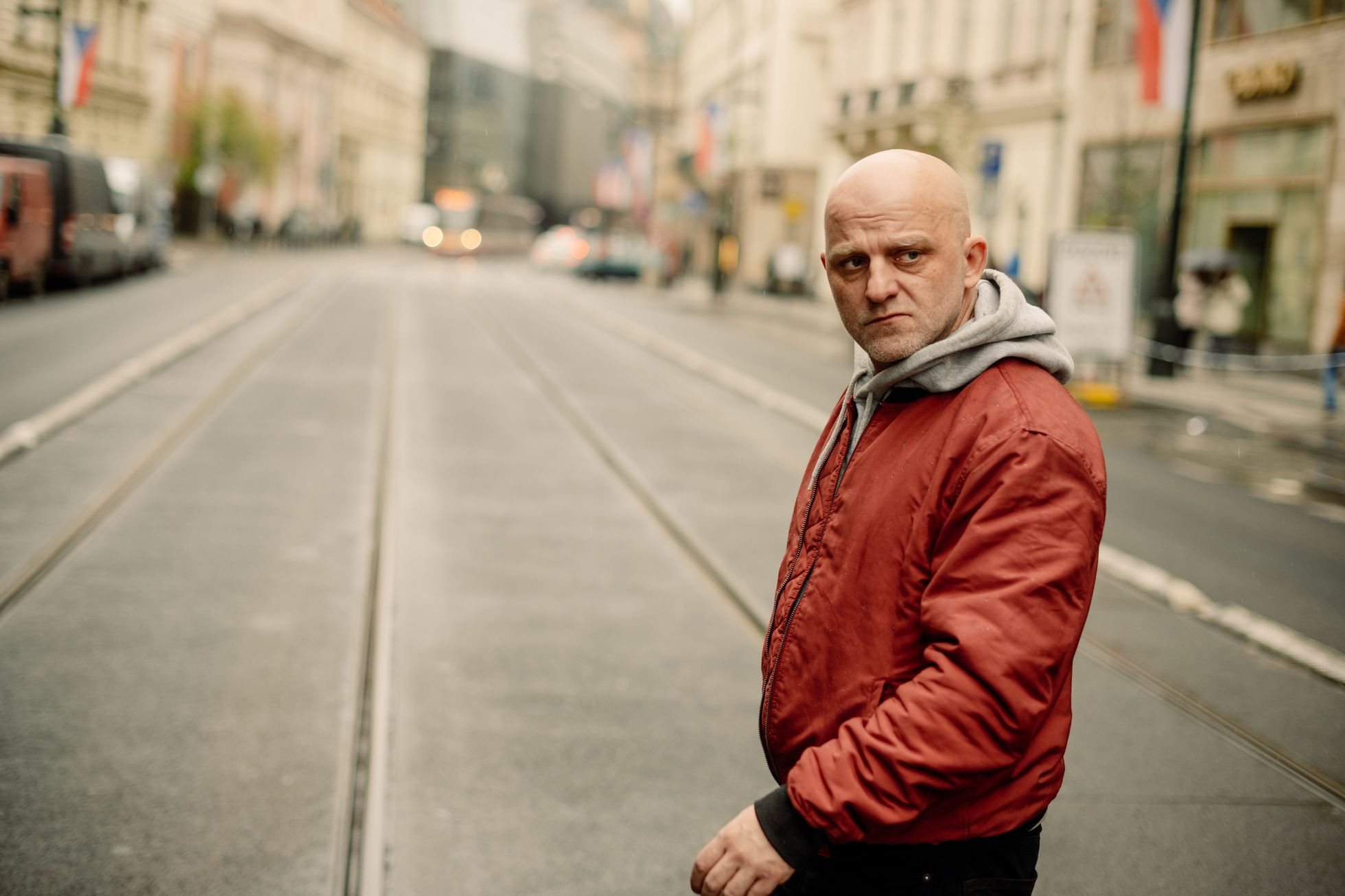
Never drink in a pub with a flat roof, or so the joke goes back in the UK. It refers to the type of dismal drinking establishments that sprang up on post-war housing estates, where you might encounter all sorts of dodgy characters, addicts and psychos. The same goes in the Czech Republic, too – you might run into a nutter like Vandam (Hynek Čermák) in Štěpán Altrichter’s National Street.

Vandam is the resident hard man of the drab Severka pub in a southern Prague project. They call him Vandam because he can do 200 push-ups, just like his VHS hero, Jean-Claude Van Damme. With his skinhead, stocky build and menacing brow, it’s no surprise to find out he has racist and homophobic views and doesn’t mind sharing them. He wants everyone to know he’s a proper fighter. “Peace is just the intermission between wars,” he growls on his voice over, with the attitude of a man who views life as a long series of battles.  He is also known to the other denizens of the pub as a national hero, the man who sparked the Velvet Revolution by throwing the first punch…

Continue reading “National Street (Národní třída) – Štěpán Altrichter, 2019”

The Snake Brothers (Kobry a užovky) – Jan Prušinovský, 2015

Right from the get-go, we know Petr “Cobra” Šťastný (Kryštof Hádek) is trouble. We open with a scrolling shot of summer cottages. It is a quiet day apart from birdsong and the distant sound of someone mowing grass. Against this peaceful backdrop, we see Cobra, strutting along with purple hair, a camo jacket and a pair of bolt cutters strapped to his back. We don’t know what his situation is yet but he’s wired, a bundle of nervous energy. He then proceeds to break into a cottage, steal all the electrical goods and make off with his loot, all under the nose of an elderly neighbour.

Cobra is one half of the Snake Brothers, two guys in their thirties trying to eke out a living in Nowheresville, CZ, in Jan Prušinovský’s impressive film follow up to Sunday League. The elder Šťastný sibling is Vojtěch (Matěj Hádek, Kryštof’s real-life big brother), known as “Viper” to his friends. He’s marginally more well-balanced, in that he is capable of getting a job and living a semi-normal existence. No matter how hard he tries to get a foothold, he is held back by his disreputable younger brother, who is always getting himself into trouble with the law.

The Snake Brothers form a trio with Tomáš (Jan Hájek), Viper’s best friend. He’s a dour, frustrated mechanic and abusive husband to the irresponsible Zůza (Lucie Žáčková), who has been hanging around on maternity pay for the past eight years while bringing up their two kids.

After Viper angrily quits his job at a factory, an old school friend, Ládík (David Máj), offers him an opportunity to become a franchisee for a German company importing cheap fashion wear. Viper sees it as a chance to better his life but doesn’t have the ready cash to make a go of it. Luckily his granny (Věra Kubánková) is happy to put her house up as collateral.

Ready for business, Viper rents a unit in a shopping centre and hires Zůza as a cashier while also trying to keep Cobra away from his customers. It turns out that Ládík is using the venture to import more than just budget brand shoes. Plus the combustible combination of Cobra, Zůza and Tomáš means that trouble is never far away…

Continue reading “The Snake Brothers (Kobry a užovky) – Jan Prušinovský, 2015”

Loves of a Blonde (Lásky jedné plavovlásky) – Miloš Forman, 1965

Loves of a Blonde 1

Andula (Hana Brejchová) works in a shoe factory in a small town where, thanks to inept state planning, women outnumber men by 16 to 1. She shares a dorm in a dreary hostel with several other women of her age, and despite the odds has a good-looking boyfriend called Tonda. He’s bought her a ring and told her the stone in it is a diamond. She wants to believe it.

Loves of a Blonde was Miloš Forman’s sophomore effort after Black Peter (Černý Petr) and is a key film of the Czech New Wave. The title may well be ironic. While Andula certainly seems to have no trouble attracting the attention of the opposite sex, the men in her life don’t seem even remotely capable of giving her the relationship she needs. She is quite worldly compared to some of her friends, but still dreams of love and romance – we can tell that from the opening scene, where she is cuddled up in bed with one of her friends cooing over the ring.

Buy Loves of a Blonde from Amazon HERE

Tonda, despite his respectable portrait pic, turns out to be an aggressive, possessive moron and the other guys in the movie aren’t much better. At a village dance, Andula and two friends are approached by three sleazy middle-aged soldiers who are stationed nearby. Their idea of wooing the girls is to get them drunk and take them for a quick knee-trembler in the woods nearby…

Continue reading “Loves of a Blonde (Lásky jedné plavovlásky) – Miloš Forman, 1965”

The Way Out (Cesta Ven) – Petr Václav, 2014

It has been a long time since a film altered my view of the world I live in. Petr Václav’s Cesta ven did just that, exposing the reality of life for the Czech Republic’s Roma community. It also  made me realise, living as I do in my cosy expat bubble, that it would take a bizarre and unlikely set of circumstances for me to ever come close to the levels of poverty and hopelessness experienced by the characters in this eye-opening slice of social realism.

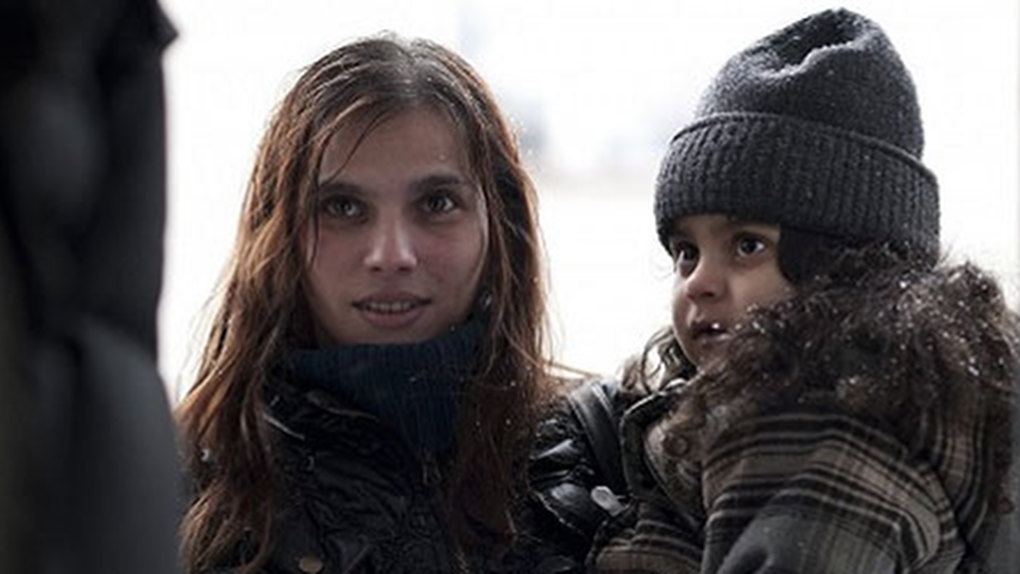
Working with non-professional actors, Cesta ven centres around Žaneta (Klaudia Dudová), a young Romani mother trying to make ends meet against a grim backdrop of unemployment, debt, criminality, alcoholism, prostitution, poverty and racial prejudice which forms the day-to-day reality of her embattled community within the community.

Continue reading “The Way Out (Cesta Ven) – Petr Václav, 2014”