Lee is an English writer, blogger and film critic living in Brno, Czech Republic. When not watching and writing about movies, he loves football, reading, eating out, and enjoying his adopted home city with his girlfriend and two children.
A subtitle for this anthology of short films based on the stories of Bohumil Hrabal may as well be “The Czechoslovak New Wave in a Nutshell”, as it showcases the work of five of the movement’s then up-and-coming directorial stars: Jiří Menzel, Jan Němec, Evald Schorm, Věra Chytilová and Jaromil Jireš. While the garrulous voice of the author comes through loud and clear in all segments, each director uses their tale as a framework for their burgeoning filmmaking talents.
First up is Menzel, who was the only one of the five who didn’t already have a full feature under his belt, but would go on to have a rewarding long-standing collaboration with Hrabal with films such as Closely Watched Trains, Cutting it Short and I Served the King of England. In The Death of Mr Baltazar, we follow three ageing petrolheads to a day at the Moto GP in their vintage 1931 Walter Convertible, a rickety old jalopy still capable of transporting six butchers and a bed. While the crowd wait for the race to start, they trade stories with another elderly spectator about all the horrific accidents they have witnessed. It’s almost as if they watch the sport to see which rider will come a cropper next and, sure enough, the day’s race adds another fatality to their highlight reel.
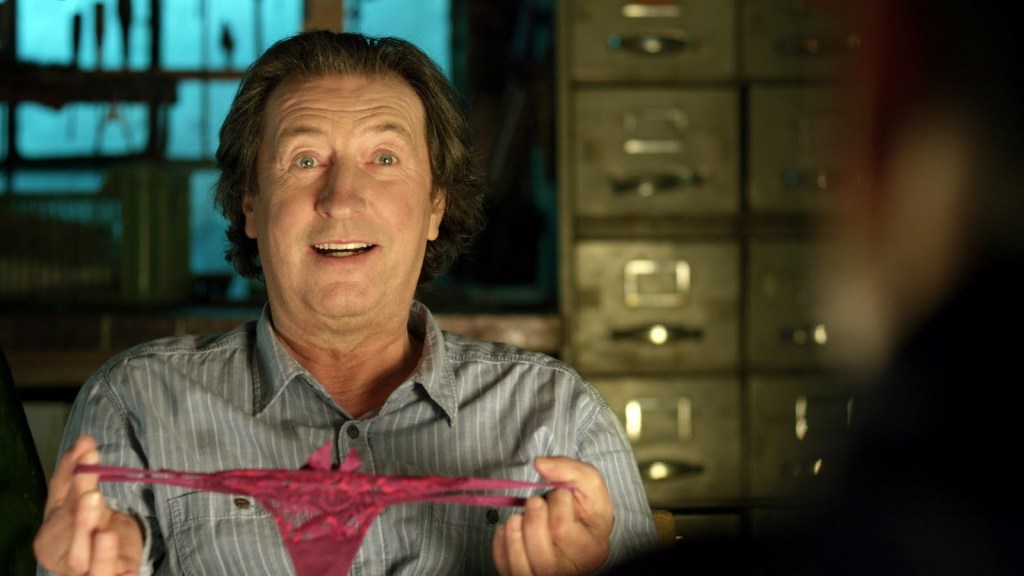
As Ronan Keating, that perennial purveyor of pop pap, once sang: “Life is a rollercoaster, just gotta ride it” – that’s the happy-go-lucky ethos of Men in Hope‘s Rudolf (Bolek Polívka), an ageing lothario and Prague cabbie with 138 extra-marital affairs under his belt. He previously had a very movie-land former career as an international rollercoaster designer, providing him ample opportunity to cheat on his wife, and gives us a handy metaphor for his attitude towards relationships. As a man who spent his life building fairground thrill rides, he knows all about the twists, turns, ups, downs and loop-the-loops that only an adulterous lifestyle can offer.
Rudolf reasons that a well-timed affair can save a relationship. He prides himself on never getting caught in over 35 years of marriage to his wife, Marta (Simona Stašová), and she benefits too. Having a series of flings with much younger women gives him a little extra energy when it’s time to perform his husbandly duties at home.
This philosophy is met with mild disapproval by Ondřej (Jiří Macháček), Rudolf’s downcast, browbeaten son-in-law, a former accountant who runs a failing restaurant with his frosty wife Alice (Petra Hřebíčková). Their marriage is stuck in a loveless rut, but Alice wants another baby and times their intimate moments accordingly. This puts pressure on Ondřej to come up with the goods as he worries about his fertility.
Things change when Ondřej meets Rudolf’s latest date, Šarlota (Vica Kerekes), a curvy red-headed bombshell who has been doing community service as penitence for dancing naked in a fountain. She has a special way of putting a smile on a guy’s face, and despite his misgivings, Ondřej can’t help but brighten up in her presence.
Before we know it, Šarlota tracks Ondřej down to his customer-free restaurant and starts an affair with him. Cheating on his wife peps Ondra up – he suddenly starts taking pride in his business, showing a little flair in the kitchen, as well as finding a bit more va-va-voom in the bedroom. Rudolf’s philosophy seems to be paying dividends when a sudden tragic event changes his point of view…
Once on a family holiday, we were walking around the side streets of a small Welsh town when we stumbled upon an old bric-a-brac shop that was closed for many years. Among the dusty collection of forlorn objects in the window display sat a vintage doll with braided hair, a straw hat, and a yellowed cotton dress. Her cheeks were webbed with tiny cracks and one of her eyes was missing. With her remaining eye, she gazed out across the universe like a martyr in a medieval painting. A huge dead spider lay curled up in her lap.
That image really troubled my childhood imagination, filled me with a terrible sense of nausea. It is the same feeling I got years later when I first saw Jan Švankmajer’s Jabberwocky, which is celebrating its 50th anniversary this year. His use of musty found objects in his animation, including dolls like the one sitting in that shop window years ago, disturbs me to this day.
Strangely I consider this a good thing, and with this in mind, I thought I’d check out Švankmajer’s final film, Insects. The blurb states that it is based on the play Pictures from the Insects’ Life by Karel and Josef Čapek, although that is a little misleading. The film finds Švankmajer in a playful mood, seemingly determined to do everything apart from shoot a straightforward adaptation of the satirical work.
After a cold open where we see a middle-aged man dressed in bug wings and goggles hurrying along the street, Švankmajer appears before the camera himself to provide a foreword for his new feature. The brothers Čapek wrote the play in 1924 while Hitler was sitting in a pub scheming his terrible schemes and Lenin was building his first gulags. Meanwhile, the Czechs and Slovaks were enjoying their newly founded republic, and people found the Čapek’s play a bit too pessimistic for the times. It was sheer youthful misanthropy, he tells us, and only gained greater relevance as the momentous events of the 20th century unfolded.
All very interesting, you might think, and this foreword certainly whetted my appetite for the adaptation that was to follow. However, that is when Švankmajer goes deliberately off-script, flunking his lines and warning us of the chaos to follow…
I’ve reviewed quite a few older classics recently, so this week I decided to play Random Czech Movie Roulette with some of the newer content on Netflix. I landed on Milan Cieslar’s “romantic comedy” Špindl…
Oh dear.
Well, I said from the beginning that my blog would cover all Czech movies, including the bad ones, so here goes…
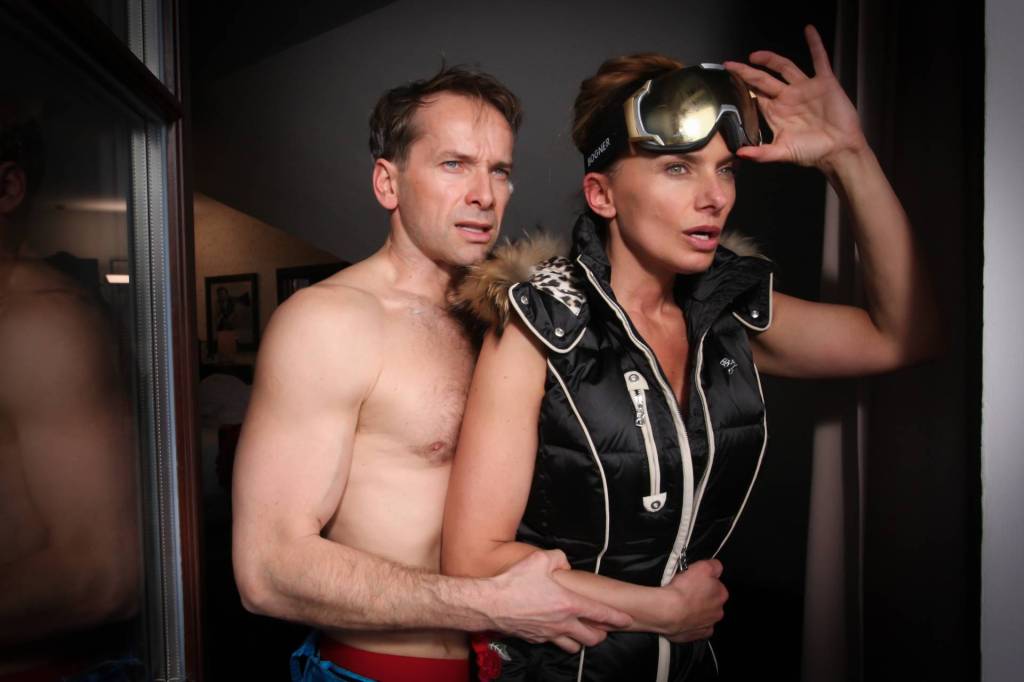
Anna Polívková stars as Katka, a sad sack singleton in her mid-thirties (something of a recurring role for her) who hates her job and dreams of one day finding Mr Right. I feel a bit sorry for Polívková. Firstly, she is following in the footsteps of her father, Bolek Polívka, one of the greatest living Czech actors. Secondly, she keeps finding herself in lame sex comedies like Špindl and Holiday Makers, or playing second banana to her illustrious dad in terrible sequels like The Inheritance 2. I’m still getting over the scene in Holiday Makers where she lets a 13-year-old boy grope her breasts to help “cure” him of his suspected homosexuality.
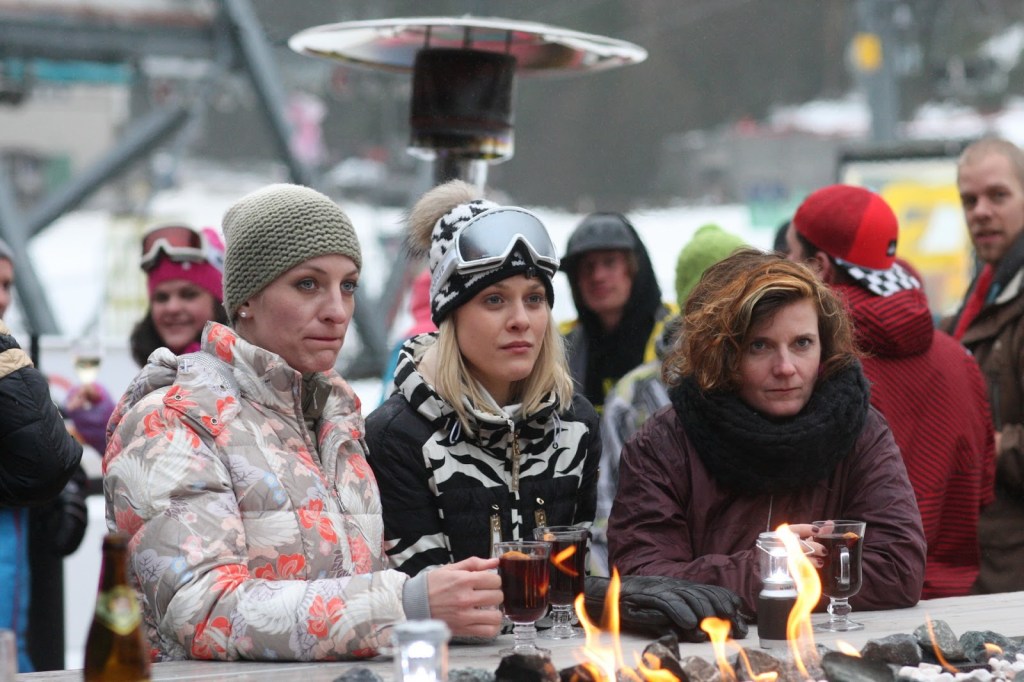
Anyway, Katka is down in the dumps and sharing her woes with her two sisters – worldly, tattooed artist Magda (Anita Krausová) and happy-go-lucky model Eliška (Kateřina Klausová). Eliška has a surprise to cheer her up. She has paid for three all-inclusive tickets to the mountain resort of Špindlerův Mlýn for a week of skiing, boozing and picking up guys. Who knows? Maybe one of them could be the Mr Right Katka is hoping for…
Also on his way to the mountains is Tonda (David Gránský), a young musician joining the resort’s resident band headed by Mrkvička, a slovenly middle-aged rocker played by Jakub Kohák, the Czech Republic’s hairiest living celebrity. Tonda hopes that the rock ‘n’ roll lifestyle will improve his chances with the ladies, and his new bandmates are all too happy to help out.
On arrival in the resort, the girls meet Lukáš (Roman Blumaier), supposedly the hotel owner whose welcoming spiel announces “Americans have Las Vegas; Czechs have Špindl” – promising a week of fun and frolics that they won’t need to take home with them unless they really want to. Straight away, things take a turn for the worst. The swanky ski lodge Eliška reserved has double-booked, so they have to stay at the shabby Three Mountains hotel nearby instead.
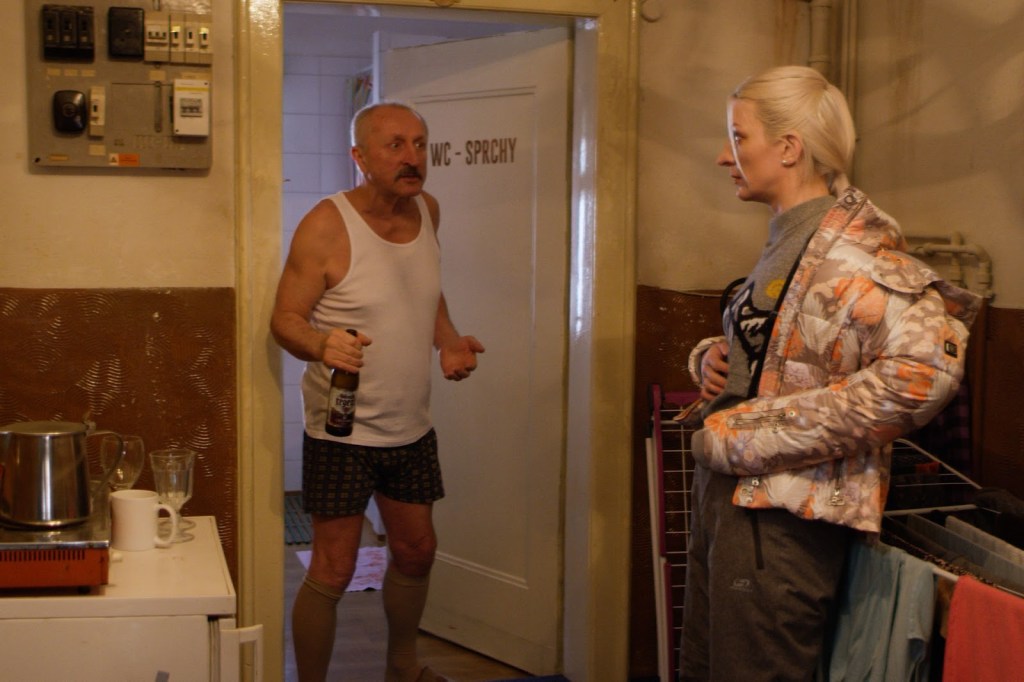
It’s a creaky old place with peeling wallpaper, paper-thin walls and nudie photos on the shared bathroom wall. Despite the setback, they decide to make a go of it and find that they must share the lodgings with the cheerfully inappropriate older couple in the next room and Tonda’s raucous band.
The next hour creeps by with a mixture of pitiful slapstick (Katka has about 700 skiing accidents), awkward gross-out humour (Eliška walks in on an old man masturbating to some vintage porn) and cringe-inducing sexual liaisons (Katka’s ill-advised date with slimy Lukáš had me watching through my fingers like it was a horror movie).
It’s all so painfully weak. It makes the unholy trinity of Michal Viewegh adaptations – Holiday Makers, From Subway with Love, and Angels of Everyday – seem like comedy classics in comparison. At least those movies had a little energy and were strangely entertaining despite their crass sexual politics. Špindl starts weak, with Polívková’s half-hearted Bridget Jones-style voice-over and Chinaski’s weak pop-rock tunes on the soundtrack, and gets progressively weaker as it goes along.
To make matters worse, it is also one of those films that thinks it’s clever by making copious references to much better movies. It has the unfortunate effect of making you wish you were watching those movies instead. Marek Vašut pops up for a scene to quote his sleazy role in From Subway with Love. The cutesy earworm “Sladké mámení” from the snowbound family classic I Enjoy the World with You gets two renditions in the space of five minutes. Later, we get a bizarre Jurassic Park reference when Tonda is chased through a hotel kitchen by a sexually frustrated older woman.
More depressing still is the film’s attitude towards sexual relationships. Like those Viewegh movies, neither sex comes off well. Špindl depicts blokes as scoundrels and cheats who are only after one thing, modern cavemen who can’t make it through five minutes without crudely hitting on a member of the opposite sex. The women are always desperate singles whose brains can’t function properly without a man’s attention, and are willing to sink to their level in the dwindling hope of finding “Mr Right”. When Mr Right finally shows up for Katka, the romantic element comes as an afterthought, in the mid-credit scenes, just before a short skit where a man sprinkles his crab-infested pubes on another guy’s head (spoiler alert). It’s all so tawdry and cynical.
The film’s saving grace is the three performances by Polívková, Krausová and Klausová, who gamely struggle with the unfunny material and somehow emerge with a little dignity intact. Polívková seems like she could be good with a decent script, but so far, I’ve only seen her in terrible movies. I can’t figure out whether she is a genuinely sympathetic screen presence or a screen presence in need of genuine sympathy.
I usually avoid saying people shouldn’t watch a movie because everyone should make up their own minds. Yet Špindl is a romantic comedy so totally lacking both romance and laughs, leaving you with a big empty nihilistic void of a movie. So I’ll conclude by saying this: watch it if you want, but it might put you off sex, skiing and human interactions for a few months at least.
Political satire can take many forms, but sometimes all that’s required is some actors, a few tables and chairs, and a patch of woodland. That’s all Jan Němec needed for A Report on the Party and the Guests, his abstract but high impact critique of life under communist rule in Czechoslovakia. It was considered scathing enough that it allegedly had Antonín Novotný, the president at the time, climbing the walls.
The concept of A Report on the Party and the Guests is about as simple as it gets. A group of middle-aged, middle-class lovers are having a picnic in a peaceful glade on a hot summer’s day. There is plenty of food and drink to go around, the weather is warm, and the friends are enjoying each other’s company. After freshening up in a babbling brook, the group are accosted by a shady little man in squeaky shoes – we later find out his name is Rudolf (Jan Klusák) – and his thuggish-looking cohorts.
Rudolf and his gang bundle the picnickers away to a clearing where he subjects them to an impromptu interrogation. The group are separated into men and women and locked up in an imaginary prison marked by a line drawn in the dirt, with two rocks representing a door.
The picnickers uneasily play along with Rudolf’s game for a while, with Josef (Jiří Němec) acting as their spokesperson. Conversely, Karel (Karel Mareš) gets fed up and grumpily storms off, crossing the line of their prison. In response, Rudolf instructs his mob to chase after the escapee and torment him a bit.
The game is interrupted by a suave older gent in a shining white jacket, known only as the Host (Ivan Vyskočil). He apologises for Rudolf’s actions and charms the group, especially the ladies, and invites them to his birthday banquet by the lake. The picnickers are quickly intermingled with the other guests when they are all assigned seating away from each other. Any complaints are forgotten with the plentiful food and drink on offer, and Josef is rewarded for his attempt to parley with a seat at the head table.
As the celebrations progress, it soon becomes apparent that one of the picnickers, a taciturn man who quietly refused to suck up to the Host previously, has discreetly left the party…
After a lean and troubled wartime era, Walt Disney started the 50s with a trio of the studio’s most beloved films – Cinderella, Alice in Wonderland and Peter Pan. This was the Silver Age of Disney, and it lasted until Uncle Walt passed away during the production of The Jungle Book in 1966.
Around the same time across the Iron Curtain, Jiří Trnka, a Czech film maker referred to as the “Walt Disney of the East” was creating a stunning series of hand-crafted animated features. After an early career illustrating children’s books and learning puppetry, he made his own animated shorts at the end of WWII. His first film with stop motion puppet animation was The Czech Year(Špalíček), which detailed the rites and customs of a small Czech village. It was well-received internationally, picking up prizes in Paris and Venice.
After two more features, The Emperor’s Nightingale and Prince Bayaya, his next major work was Old Czech Legends, based on Alois Jirásek’s novel. Divided into seven parts, it takes us way back to the mythological foundation of the Czech nation. It opens with a dramatic note of despair as a tribe is mourning the death of their kind and noble leader, Forefather Čech. In a flashback, we see how they came to the Vltava after a long and arduous journey and rested near Říp mountain. Čech scaled the mountain alone and saw the bounteous and beautiful land all around him, and declared that this was the place for his people. In gratitude, they insist on naming the country after him…
The nominations for this year’s Academy Awards dropped this week, and the Best Picture category includes no less than two of the most Oscar-baiting of movie genres: the biographical feature. Biopics often tend to be well made and impressively acted, with an air of respectability that makes them very awards-friendly. However, they are also limited by the cinematic medium itself, trying to cram the remarkable events of a complex human being’s life into the time it would take that person to… well, watch a movie.
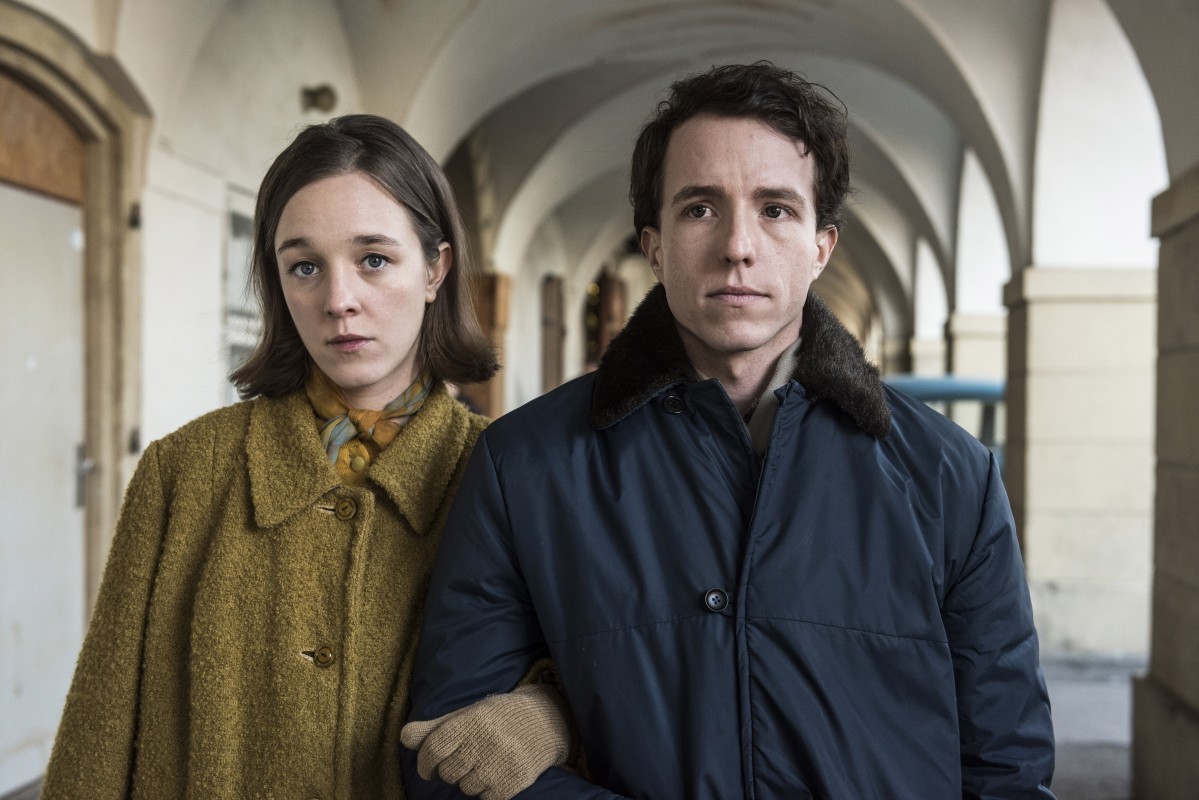
Robert Sedláček’s Jan Palach makes things a little easier for itself by narrowing the focus to the last year or so of the martyr’s life. After a brief intro set in 1952, where we see Palach as a young child lost in the snowy woods, we fast forward all the way to 1967 where he is now a student (Viktor Zavadil) digging ditches at a work camp in Kazakhstan. The work is hard and the food is basically gruel, but the sun is shining and there are girls to chat up. Here we get some sense of Palach’s strength of character when he sticks up for a Russian pal who gets in trouble with the Communist camp boss for boycotting the food.
After that, it’s back to Prague where Palach spends his time juggling his studies, a rather chaste romance with his girlfriend Helenka (Denisa Barešová) and visiting his widowed mother, a Communist Party member who can’t resist opening her son’s mail if it looks any way official. He gets accepted to Charles University and enjoys being in the presence of lively, politically engaged fellow students. In the background is increasing unrest, culminating in the Prague Spring of 1968.
Palach is enjoying another work-holiday in the vineyards of France when news of the Warsaw Pact troops subduing the rebellion reaches him. He returns home to Prague to find civilians standing up to tanks and guns without any backing from the Czechoslovak authorities, and sometimes paying with their lives.
Palach and his girlfriend are involved when a student protest is brutally put down by the police, and both take a beating for their troubles. Scared and demoralised, the student activists start shying away from further action, leading Palach to devise a shocking solo demonstration of his own…
Hedwig Eva Maria Kesler, better known as Hedy Lamarr, led a life as eventful as any of the characters she played on screen. Shortly before World War II, she ran away from her native Vienna to escape from her possessive husband, a rich arms dealer with ties to Mussolini and Hitler. Once in London, she met Louis B. Mayer, the head of MGM, who signed her up and promoted her as “the world’s most beautiful woman”.
Mayer persuaded her to change her name to Lamarr, putting a little distance between her controversial breakthrough role in Ecstasy, and she went on to have a successful career in Hollywood. During the war, she got together with her composer friend George Antheil to invent a frequency-hopping signal to prevent Allied torpedos from being tracked or jammed. In her later years, she opened a ski resort, got nicked for shoplifting, and gradually became a recluse. She also married and divorced six times before spending the last thirty-five years of her life single.
I heard about Ecstasy ages ago because of its two controversial scenes: one where our protagonist does a bit of skinny dipping, and another where she reaches an orgasm with her lover. I approached it with some caution because I sometimes struggle with pre-war movies, often finding them too dated and the cinematography too static and boxy. I was concerned that Ecstasy would be a chore, but luckily there was nothing to worry about…
The story is so slight that you could fit it on the back of a monogrammed handkerchief. We open with a happily married couple – Emil (Zvonimir Rogoz), a wealthy older man, and his luminous young bride Eva (Lamarr/Keisler), about to step across the threshold on their wedding night. We can see there are problems right away – Emil is drunk and can barely carry her into the apartment. While she eagerly awaits to consummate their marriage, he falls asleep in the bathroom.
In the following days, Emil is content to ignore his young wife, preferring to read his newspaper. She becomes increasingly dismayed by his distance and starts to feel lonely in their marriage. Quickly realising that they are not suited to each other, she files for divorce and returns to live with her father on the ranch.
One morning she awakes and decides to go for a horse ride and stops by a lake for a swim. Her horse runs away with her clothing, leaving her chasing behind naked. The horse attracts the attention of a hunky engineer called Adam (Aribert Mog). He is struck by the sight of the beautiful young woman hiding her modesty in the bushes before eventually giving her clothes back.
She doesn’t like him at first but can’t sleep for thinking of him. She returns to his hut and they make love. She finds fulfilment with Adam, but little does she know that a chance encounter between her new lover and Emil will lead to tragedy…
Sometimes a film just doesn’t grab me at all and then I’m sat looking at a blank document thinking, “I don’t know if I can be bothered to write anything about this”. It is extra frustrating when I can see the film’s qualities, but feel so neutral towards it that I struggle to muster any enthusiasm.
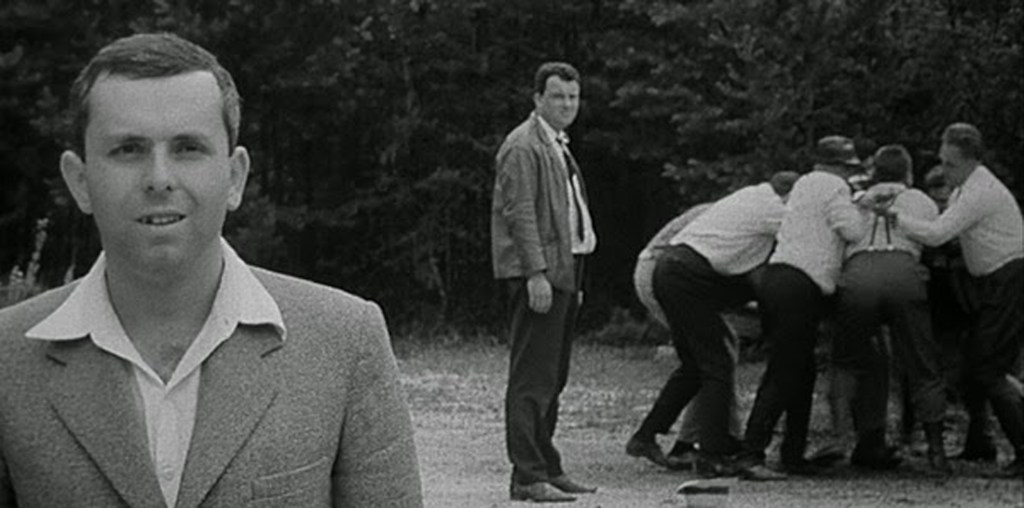
One such film is Juráček & Schmidt’s Joseph Kilian, a paranoid short drama from the Czechoslovak New Wave. Knowing that the review is going to be a battle, I face a dilemma. Do I –
a) Give up on the movie and watch something else, then maybe come back another time when a change of mood or circumstances might make it chime differently.
b) Plough ahead regardless and eke out 700-800 words on it, going through the motions and stating the obvious, like the clear influence of Franz Kafka and blah blah blah.
Or
c) Find a hook, a way to approach the film that will entertain me and, in turn, hopefully make the article more entertaining for the reader. My first instinct with Joseph Kilian is to go with option C, but what is the hook?
A woman clad in black, starkly contrasted against the sun-bleached seashore, skulks like a cat between the rocks after disposing of a vial of poison. She spots her servant girls below, laughing and swimming naked in the sea. Jealous of their youth and vivacity, she picks up a rock and hurls it at the back of one of their heads, crippling a girl for life…
A few years after Juraj Herz gave us one of the great movie villains in The Cremator, this act of sheer malice is just a tea break in the murderous schemes of another memorable antagonist in Morgiana. A monstrously melodramatic adaptation of Alexander Grin’s novel Jessie and Morgiana, it is the tale of two diametrically opposed sisters. Klara Trangan, dressed all in white, is simple, naive, and kindhearted – annoyingly so – while her gloomy, covetous sister Vitoria lurks around like a grudging shadow. Both are played by Iva Janžurová, and the illusion is pulled off so well through acting, costume, make-up and camera tricks that it took me half the movie to realise it was the same actor.
Things kick off after the Trangan sisters’ father dies, and his wealth and estate are divided between them in his will. They are both very well provided for, but there is little doubt that Klara got the sweetest inheritance, receiving a sprawling villa and its grounds overlooking the sea, while Viktoria gets some land and a haunted hunting lodge. To further inflame Viktoria’s grievances, Klara also attracts the attention of two handsome suitors – the grave lawyer in charge of their father’s will, Glenar (Petr Čepek) and gallant military man Marek (Josef Abrhám).
Viktoria retreats to her hunting lodge to sulk with her cat, Morgiana, where she hatches a plot to kill her sister with a slow-acting poison that is impossible to trace. So slow-acting, in fact, that she doubts whether it is working at all until Klara starts experiencing hallucinations and a unslakeable thirst. By which time she has also tried it out on a servant woman’s dog to make sure she wasn’t sold a lemon.
Rumours of Klara’s maladies reach Otylie (Nina Divíšková), the purveyor of the poison, who then shows up wearing a very big hat to blackmail Viktoria. Unfortunately for her, she underestimates how murderously batshit crazy the wannabe poisoner is…






 Sometimes a film just doesn’t grab me at all and then I’m sat looking at a blank document thinking, “I don’t know if I can be bothered to write anything about this”. It is extra frustrating when I can see the film’s qualities, but feel so neutral towards it that I struggle to muster any enthusiasm.

 Czech Film Review