There is an old Les Dawson joke that goes like this: I said to the chemist, “Can I have some sleeping pills for my wife?” He said, “Why?” I said, “She keeps waking up.”
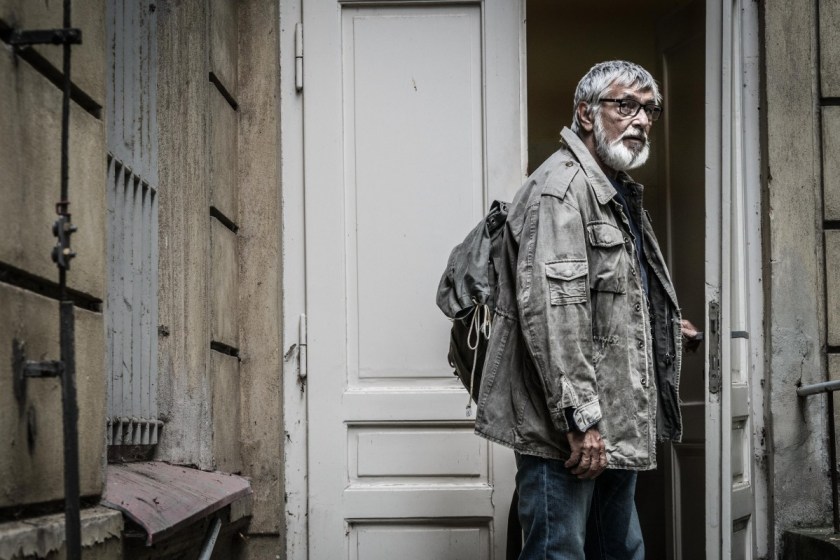
That is pretty much the attitude of the main character in Tiger Theory, Radek Bajgar’s dramedy about a sixty-something who finds an unconventional way of leaving his controlling wife.
Jan Berger (Jiří Bartoška) is a veterinarian. We first meet him as performs the snip on a tomcat, much to the gratitude of its female owner. It’s a none-too-subtle metaphor for the film’s central thesis, in that most of the male characters feel emasculated by their wives. The only guy who doesn’t has a problem with his sperm and possibly gets cheated on by his free-spirited wife, implying he’s not man enough to get the job done.
The film sets out its stall early, with Berger’s wife Olga (Eliška Balzerová) delivering a lecture to a group of students about the life expectancy of men. They drink more, smoke more and eat unhealthily, all of which affects their longevity. And it is the woman’s lot to keep control of their man’s worst impulses, she asserts.
One of my favourite folk tales from back home is the Wild Man of Orford, a small coastal village not far from where I grew up. In the 12th Century, a group of local fishermen hauled their nets to discover they’d caught a strange naked man covered in greenish hair. He was taken to the nearby castle for interrogation, but after six months his torturers realised he wasn’t able to speak.
After that they let him exercise in the sea, stringing nets across the harbour so he couldn’t escape. The Wild Man easily swam under them, but each time he returned willingly to the castle. Eventually, he tired of life on the land, slipped under the nets one last time and vanished out to sea.
A similar water-dwelling character from the landlocked Czech Republic is the vodník, or hastrman, a water goblin popular in fairytales and made famous by folklorist Karel Jaromir Erben in his collection of ballads, Kytice. The creature lives in bodies of water and is capable of drowning the unwary if he’s in a bad mood, or providing bumper catches of fish for the locals if kept happy with sacrifices and offerings…
I originally wanted to open this review with a good quote about life, and there are thousands and thousands of them online, ranging from the sage advice of Gandhi to the witticisms of W.C. Fields. In fact, when you type “quotes” into Google, “about life” is its first suggestion. So that means that either – a) there are tons of people out there writing reviews about tender character studies like Beata Parkanová’s Moments or b) millions of people every day are searching for a little inspiration to help them make sense of this bewildering rollercoaster we call Life…
One Saturday night in the early ’80s, a man goes home early from the pub to watch the football highlights on Match of the Day. He settles down in front of the TV with a fresh beer, but the broadcast hasn’t started yet. He turns over to see what’s on the other two channels and drops into a strange film about identical twins, time travel and Nazis.
He becomes so engrossed that he watches to the end, missing the footie. On Monday morning he goes to work and tells his mates about this peculiar film, but no-one knows what he’s talking about. He doesn’t know the title because he missed the start, and trying to elaborate on the plot just makes him sound crazy…
You can watch On the Roof (Na střeše) right HERE with our View on Demand partner Eyelet
There was a time when every pub and restaurant in Brno seemed to be competing for the title of the city’s best burger. Everyone I knew had an opinion on whose was top, and my own pick wasn’t too popular with pub-owner friends who prided themselves on their homemade patties.
A new craze put paid to all that nonsense, and we partially have the country’s burgeoning Vietnamese community to thank for that – suddenly everyone was head-over-heels for Bún bò Nam Bô and Bánh mì sandwiches.
Vietnamese immigrants began settling in Czechoslovakia during the Communist era, arriving as guest workers invited by the government. Nowadays Vietnamese people make up the Czech Republic’s third-largest ethnic minority, after Slovaks and Ukrainians.
The first Czech film I’ve seen so far that touches upon the Vietnamese-Czech experience is Jiří Mádl’s On the Roof, a comedy-drama that focuses on the growing friendship between a lonely old man and a desperate young immigrant…
Alois Švehlík plays Antonín Rypar, a cantankerous retired professor living alone in his top floor apartment in Prague. He doesn’t have much time for people, and people aren’t too keen on him either – especially when they find out he was a communist during the soviet era. His wife left him a long time ago, taking their son with her, and he hasn’t heard from them in years – he’s isolated and regretful.
One day he pops up to the roof for a smoke and finds a distraught young Vietnamese guy, Song (Duy Anh Tran) getting ready to jump. Song has escaped from the marijuana farm where he was forced to work before it was raided by the police. Now homeless and on the run, Song is about to end it all.
Antonín talks Song down and gives the hungry and frightened young man some food while treating him to his bigoted ideas. The old man is angry at the state of the world and thinks the answer to the country’s problems is to close the borders and prevent illegal immigrants from getting in, a view that will strike a topical nerve with audience members on both sides of the argument.
Despite this, Antonín begrudgingly enjoys Song’s company and offers him his spare room, in exchange for some free cleaning. He strikes upon the idea of finding Song a Czech bride so he can stay in the country legally, and the pair secretively turn their attention to the attractive young woman living across the hall…
On the Roof takes a bunch of modern social issues and lightly squeezes them into the shape of an odd-couple movie, which hits all the comedic and dramatic beats you’d expect. The pair are distrustful at first but soon start to benefit from each other – Antonín helps Song learn Czech, while Song teaches the old man how to use Facebook to woo their pretty neighbour. You see, friendship isn’t bound by age, race or language…
Then, just when I was about to write off On the Roof as an entertaining but formulaic movie, it pulled out a genuinely surprising and touching plot turn in the final act that left me grinning. I won’t give it away but if I was the type of reviewer to give star ratings, that one thing would be enough to upgrade this from a three-star movie to a four-star one.
On the Roof was originally intended as a vehicle for Jan Tříska (The Elementary School), who sadly died just before shooting began. Alois Svehlík stepped into the role of Antonín and he’s terrific. Irritable and defiant, Antonín is a man who knows his time is coming slowly to an end and isn’t happy about it all. While he’s a redoubtable character, his loneliness makes him strangely vulnerable and regret haunts his eyes. Svehlík plays him sternly without ever trying to make him seem like a loveable old gent.
Duy Anh Tran makes an interesting foil for Svehlík’s crotchety old-timer, giving an emotional, unguarded performance as Song. He’s scared and alone until his friendship with Antonín encourages him to slowly come out of his shell.
The pair work off each other well and they manage to sell the film’s unlikelier elements, especially during the scenes when they’re trying to flirt with the neighbour without letting her know who’s doing the flirting. Together, the two actors make their character’s budding bromance worth rooting for – they are so good that I just wish they were in a better movie.
Don’t get me wrong, there’s nothing bad about On The Roof. In fact, it’s a perfectly enjoyable evening’s entertainment. It’s a decent watch, just be prepared to feel a little undernourished afterwards.
Vit Olmer’s bawdy comedy Tank Battalion (Tankovýprapor) made history as the first privately produced Czech film after the Velvet Revolution. And what did they decide to make a movie about after four decades under an oppressive Communist regime? You’ve guessed it – a movie about life under an oppressive Communist regime…
Based on the semi-autobiographical novel by Josef Škvorecký, the film is set in 1953. We meet intelligent, demob-happy Staff Sergeant Danny Smiřický (Lukáš Vaculík) who has almost finished his two-year stint in compulsory military service. In between tank manoeuvres and covering his mate’s guard shift in the stockade, there’s little for him to do apart from smoking cigarettes, try to avoid flak from his perpetually enraged commanding officers, and dream about an unobtainable girl he once knew in Prague.
He’s almost made it to the end of his service, but now he risks trouble by getting into an affair with an officer’s lonely wife. Tensions are also growing between the conscripts and the officers, culminating in a dangerous drunken standoff…
According to the Guinness Book of World Records, the most prolific female murderer of all time was Elizabeth Báthory, a 16th-century Hungarian noblewoman. She is said to have murdered over 600 young women, practising vampirism and bathing in their blood to preserve her own youth and beauty.
Now I don’t know what the verification process is for the Guinness Book of records (it’s been a long time since my own unsuccessful attempt to build the world’s largest pyramid out of empty beer cans) but this seems like an iffy one to me. Many of the testimonies were based on hearsay from superstitious bumpkins or extracted from “witnesses” by torture. The exact kill count is thought to be greatly exaggerated.
Buy your copy of Bathory: Countess of Blood from Amazon HERE
Going to bat for poor old Elizabeth is veteran Slovak director Juraj Jakubisko with Bathory: Countess of Blood, an expensively mounted Czech, Slovak, Hungarian and British co-production. Setting out its stall as a revisionist historical epic, the movie veers wildly between horror, political intrigue and bodice-ripping romance, with some wacky comic touches thrown in for good measure – monks on clockwork rollerskates, for example.
In short, it’s a pretty kooky way to try clearing someone’s name, as Jakubisko attempts to rescue Báthory from the naughty step of history by spinning his own unreliable yarn…
You can watch Doubles, aka Doppelgängers (Dvojníci) right HERE with our VOD partners Eyelet
In 1999, a resident of Kansas City, Missouri named Richard Jones was banged up for aggravated robbery. The crime took place across the state line in Kansas City, Kansas, where a woman was knocked to the ground in a Walmart car park by three muggers who made off with her phone. Jones claimed that he was home at the time, but eyewitnesses identified him as one of the culprits. He was sentenced to 19 years in prison.
17 years later, Jones was released when police traced the real perpetrator, Ricky Amos, Jones’s “doppelgänger” who lived on the Kansas side of the city…
The idea of the doppelgänger, or a person’s perfect double, has long caught the imagination and there are dozens, if not hundreds, of examples in literature, film and TV. More often than not, the appearance of a doppelgänger in a character’s life spells trouble.
The well-worn concept is the subject of Jiří Chlumský’s likeable crime comedy Doubles (Dvojníci). Ondřej Sokol has fun in a dual role as two men with a striking similarity to one another: Honza Rambousek, a down-on-his-luck Prague thief in debt to his crime boss, and Richard Prospal, a mild-mannered teacher who is in town for a conference…
Sometimes when digging back through the decades to find “new” movies to review, a film will stand out as something so bright and marvellous that it feels like an antidote to our cynical times, with tentpole Hollywood blockbusters and cinematic universes dominating the box office.
One such film is Karel Zeman’s wondrous Invention for Destruction, a delightful flight of fancy that continually staggers the viewer with its imagination and sense of old school adventure…
Taking ideas from several of Jules Verne’s works but based primarily on his novel Facing the Flag, it’s the story of gentlemanly megalomaniac Count Artigas (Miloslav Holub) who rules the sea thanks to his steam-powered submarine and band of pirates. The lethal craft has enabled him to amass vast wealth, plundering treasure from old shipwrecks. When there’s not a shipwreck around to plunder, he can make one, using his sub to sink merchant’s vessels.
Now the Count wants to conquer the land and the air. To this end, he kidnaps Professor Roch (Arnošt Navrátil) and his dapper young assistant, Hart (Lubor Tokoš). The professor is working on futuristic technology, not unlike the atom bomb. While he intends the new tech for the benefit of mankind, Artigas wants to use it for a superweapon. He takes the captives to his secret lair in a dormant volcano to work on his fiendish plan, picking up a pretty survivor from a shipwreck, Jana (Jana Zatloukalová), along the way…
Despite the turmoil currently on planet earth, things are looking more optimistic up in space. Only last week scientists announced that they have picked up potential signs of life on Venus and, depending on the sources, a manned mission to Mars could launch within the next 10-20 years. Ambitious initiatives like Breakthrough Starshot are looking even further afield, with a vision of sending a tiny unmanned probe to investigate exoplanets orbiting our next-door neighbour in the cosmos, Alpha Centauri.
Long-distance space travel raises many physical and mental challenges for potential crew members. How will we keep our bodies from wasting away without gravity for our muscles to fight against? How will our minds cope with the isolation and the knowledge that, for future colonists of distant planets, it may be a one-way ticket? Is there a decent curry house, and will they take visa?
Some of these questions are tackled in Jindřich Polák’s visionary sci-fi thriller, Ikarie XB-1. Based on The Magellanic Cloud by legendary science fiction author Stanisław Lem, it charts the adventures of the crew of a near-light speed ship, Ikarie XB-1, on its 28-month mission to Alpha Centauri…









 Sometimes when digging back through the decades to find “new” movies to review, a film will stand out as something so bright and marvellous that it feels like an antidote to our cynical times, with tentpole Hollywood blockbusters and cinematic universes dominating the box office.


 Czech Film Review