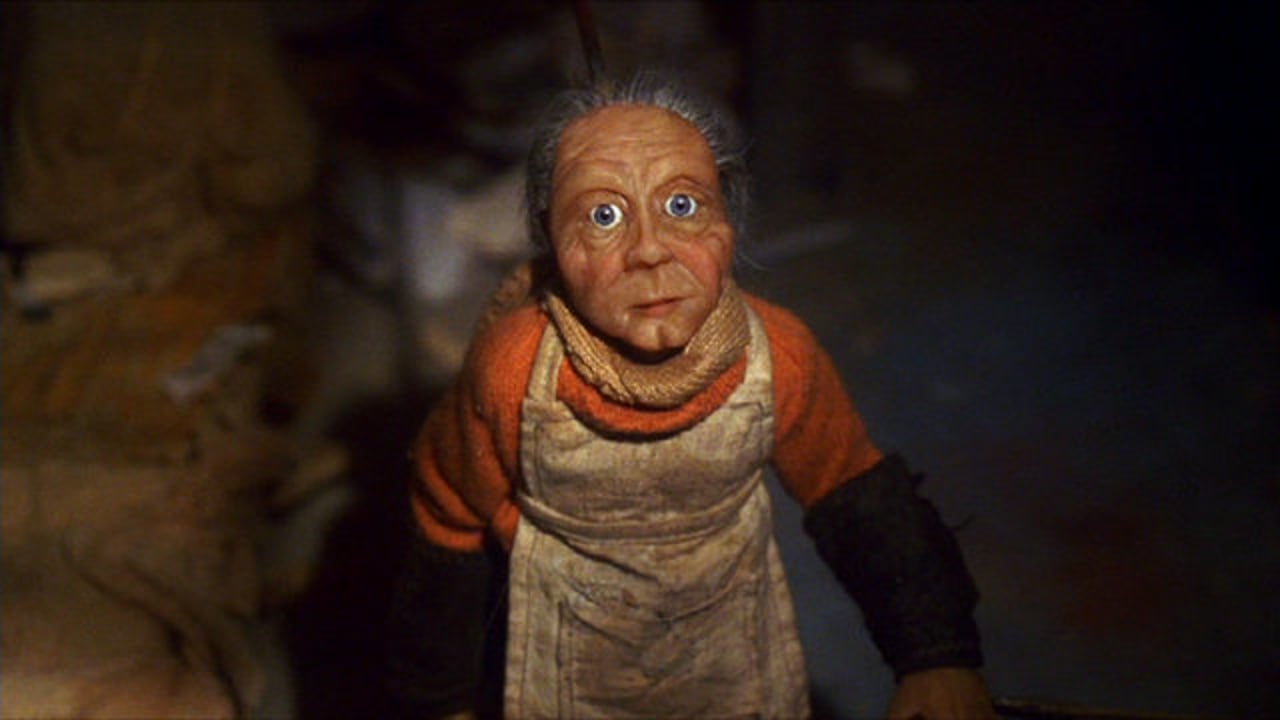
Witchhammer (Kladivo na čarodějnice) – Otakar Vávra, 1970

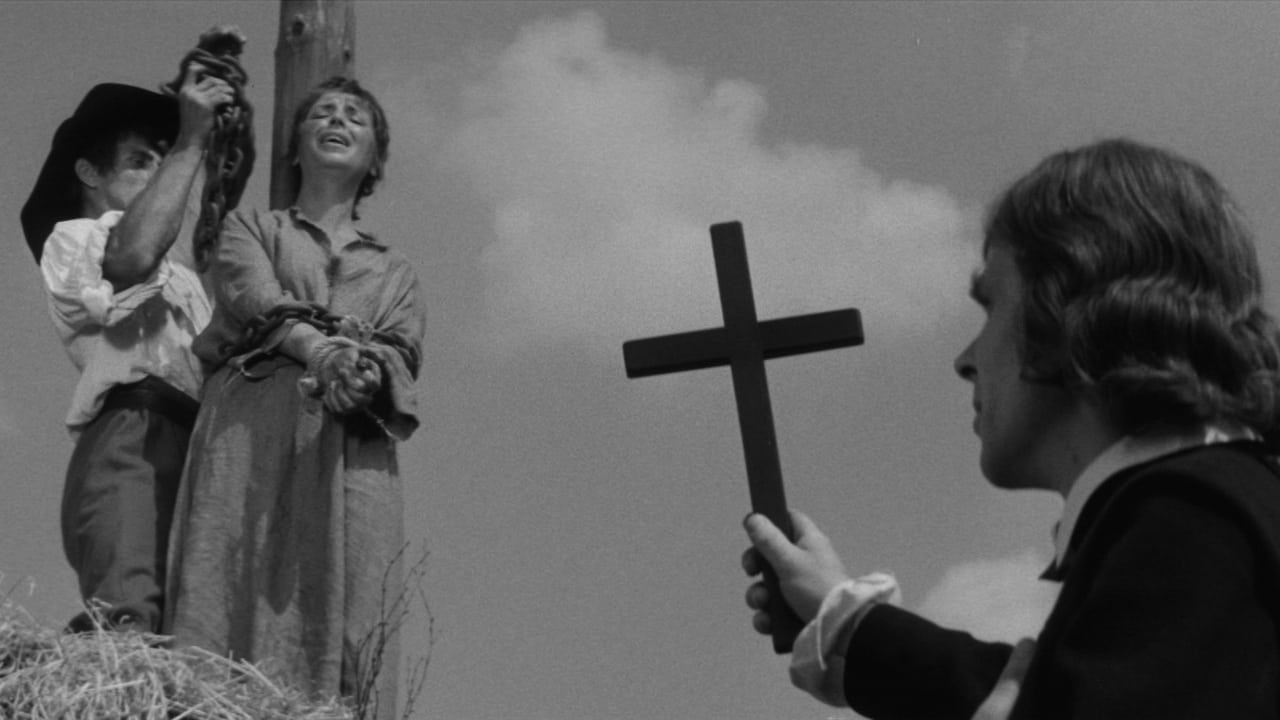
An innocent burnt at the stake in Witchhammer

“A woman’s womb is the gateway to Hell,” whispers a rabidly fanatical monk at the beginning of Otakar Vávra’s Witchhammer (Kladivo na čarodějnice), while we cut away to watch a group of women bathing nude.

It’s a provocative opening and, although Vávra had the Communist show trials of the 1950s in mind while making the film, it sets out its stall early: the problem is the patriarchy, and sexual repression goes hand-in-hand with political repression, a theme that is as depressingly relevant fifty years later. Or 300-odd years on from the events of the film. Same as it ever was.

Witchhammer Blu Ray

Buy Witchhammer from Amazon HERE

The film takes its title from the Malleus Maleficarum, a weighty 15th-century tome that details at length the procedures deemed necessary for dealing with witchcraft, including the methods of torture that were legally permissible for extracting confessions from the accused…

Continue reading “Witchhammer (Kladivo na čarodějnice) – Otakar Vávra, 1970”

Accumulator 1 (Akumulátor 1)  -  Jan Svěrák, 1994

Zdeněk Svěrák in Accumulator 1

Co-written and directed by Jan Svěrák (Kolya, The Elementary School), Accumulator 1 is an entertaining film that features a lot of interesting ideas, but they just don’t come together in a way that’s coherent enough to justify their existence.

The film features a pretty bizarre premise: people who have appeared on television are suddenly losing their energy and dying. The main character, a self-conscious man named Olda (Petr Forman) turns into a recluse after he misses his shot with the girl he’s interested in. He becomes so lethargic that all he does is watch TV for a whole week and loses consciousness for a couple of days. The paramedics save him by barging into his apartment, and at the hospital, he meets a mysterious man, Fišarek (Zdeněk Svěrák), who heals him with his special abilities.

Buy Accumulator 1 from Amazon HERE

Fišarek refers to himself as a natural healer. He helps people that have also suffered from the same condition as Olda. To reinvigorate himself, Fišarek advises Olda to gather energy from natural sources like exercise, the life force of trees, paintings, and even sexual stimulation. He teaches Olda how to harness the energy from these sources, and even shows him how to transfer energy over long distances…

Continue reading “Accumulator 1 (Akumulátor 1)  -  Jan Svěrák, 1994”

Kajínek – Petr Jákl, 2010

In May 2017 Jiří Kajínek, a gangster, robber and hardman, was released from prison after serving 23 years of two life sentences, pardoned by President Zeman. During that time he became something of a folk hero in the Czech Republic. Sent down for the brutal killing of a businessman and his bodyguard, doubts persisted about his case, with over half of Czechs believing he was wrongfully accused.

Petr Jákl’s 2010 crime saga is a pulpy retelling of Kajínek’s struggles, including his infamous breakout from Mirov prison, known as the “Czech Alcatraz”. Former stuntman Jákl directs the film like a man setting himself alight and flinging himself down a flight of stairs.

Kajinek Blu Ray

Buy Kajinek from Amazon HERE

He’s used to making situations exciting, I guess, and has no qualms about cramming just about every thriller trope there is into his movie, trying to pump as much drama as he can into each scene. It’s a heady mix of prison breakout movie, legal drama and conspiracy thriller, and it’s got the lot – sadistic screws, transparently corrupt bad guys, tense escape scenes, and bursts of gory violence…

Continue reading “Kajínek – Petr Jákl, 2010”

Loves of a Blonde (Lásky jedné plavovlásky) – Miloš Forman, 1965

Loves of a Blonde 1

Andula (Hana Brejchová) works in a shoe factory in a small town where, thanks to inept state planning, women outnumber men by 16 to 1. She shares a dorm in a dreary hostel with several other women of her age, and despite the odds has a good-looking boyfriend called Tonda. He’s bought her a ring and told her the stone in it is a diamond. She wants to believe it.

Loves of a Blonde was Miloš Forman’s sophomore effort after Black Peter (Černý Petr) and is a key film of the Czech New Wave. The title may well be ironic. While Andula certainly seems to have no trouble attracting the attention of the opposite sex, the men in her life don’t seem even remotely capable of giving her the relationship she needs. She is quite worldly compared to some of her friends, but still dreams of love and romance – we can tell that from the opening scene, where she is cuddled up in bed with one of her friends cooing over the ring.

Buy Loves of a Blonde from Amazon HERE

Tonda, despite his respectable portrait pic, turns out to be an aggressive, possessive moron and the other guys in the movie aren’t much better. At a village dance, Andula and two friends are approached by three sleazy middle-aged soldiers who are stationed nearby. Their idea of wooing the girls is to get them drunk and take them for a quick knee-trembler in the woods nearby…

Continue reading “Loves of a Blonde (Lásky jedné plavovlásky) – Miloš Forman, 1965”

Page to Screen: Too Loud a Solitude (Příliš hlučná samota) – Genevieve Anderson, 2007

“I can be by myself because I’m never lonely, I’m simply alone, living in my heavily populated solitude, a harum-scarum of infinity and eternity, and Infinity and Eternity seem to take a liking to the likes of me.”  Bohumil Hrabal, Too Loud a Solitude

Too Loud a Solitude is my favourite book, and that passage in particular resonated so deeply during my teaching days in Prague. I’ve always been someone who enjoys time with my own thoughts, and I never felt lonely while I was there. I was in love with the place and, although I had friends, I often preferred it when it was just me alone with the city…

Continue reading “Page to Screen: Too Loud a Solitude (Příliš hlučná samota) – Genevieve Anderson, 2007”

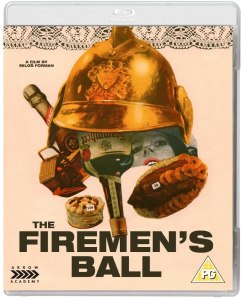
The Firemen’s Ball (Hoří, má panenko) – Miloš Forman, 1967

Miloš Forman’s last Czech film, The Firemen’s Ball, starts off as a lighthearted farce. By the time the film reaches its masterful third act, it has become a tragicomedy of tremendous allegorical power.

It can be seen in numerous ways. A literal reading got Forman in hot water with real fire crews up and down the land, who saw it as an attack on their honour and integrity, resulting in Forman touring the country to make amends. You could interpret it as an indictment of human foibles and corruptibility; a satire on corporate groupthink; or a stealth condemnation of the Communist system. The Czechoslovakian Communist party certainly saw it as the latter, resulting in the film being “banned forever”.

Buy The Firemen’s Ball from Amazon HERE

The story is slight but builds irrevocably towards its conclusion, where details that seem innocuous in the set up suddenly take on massive significance. The committee of a small-town fire department is arranging a ball. The entry is 8kc and attractions include a band, a tombola and a beauty pageant. The guest of honour is the firemen’s retired president, and the plan is to get the winner of the beauty contest to present him with a ceremonial axe for his 86th birthday.

Things quickly go south. One of the firemen, Josef (Josef Kolb), is in charge of the tombola and is panicked when the prizes start going missing before the doors even open. The committee hasn’t selected their contestants for the pageant yet, and hurriedly spend the early part of the ball trying to recruit prospects from the attendees. The selection process also seems to have an ulterior motive, as the largely middle-aged committee see it as an excuse to ogle young women…

Continue reading “The Firemen’s Ball (Hoří, má panenko) – Miloš Forman, 1967”

Loners (Samotáři) – David Ondříček, 2000

Loners (Samotáři) was the first Czech film I saw in a movie theatre. I was on a teacher training course in Prague at the time, and there was a buzz going around that it was the Czech answer to Trainspotting. I ended up getting completely rat arsed before, during and after the screening, so I couldn’t remember a single thing about it.

That complete blackout has always made Loners something I’ve been eager to revisit. Trainspotting flash-froze a zeitgeist so perfectly that it felt dated by the time it came out on video, so if Loners truly was in any way equivalent, how would it stand the test of time? It’s now half my life since that drunken cinema visit – I was in my early twenties then. What, if anything, would the movie say to me now as a father of two in my early forties?

Loners Blu Ray

Buy Loners from Amazon HERE

Well first up, the Trainspotting comparison was way off. I can kind of see why people at the time were making the analogy, as it focuses on the lives of twenty-somethings in the city and there are drugs involved, albeit ganja rather than smack. Other than that, Loners is a very ho-hum, meandering, mildly amusing look at the lives of a group of young-ish people at the turn of the Millenium. It’s unfair to compare the two really, but since I’ve already started I may as well continue by saying it also lacks Trainspotting‘s vivacity, bleak humour, empathy, and directorial verve. If Trainspotting was a howl of defiance in the dark, Loners is more like a shrug of indifference in a Starbucks…

Continue reading “Loners (Samotáři) – David Ondříček, 2000”

The Cremator (Spalovac mrtvol) – Juraj Herz, 1969

Anthony Perkins as Norman Bates in Psycho. Anthony Hopkins as Hannibal Lecter in The Silence of the Lambs. Christian Bale as Patrick Bateman in American Psycho. Everyone loves a great movie monster, and it’s a tragedy that Rudolf Hrušínský’s incredible performance as Karel Kopfrkingl in The Cremator hasn’t gained the same kind of international notoriety. He’s just as enjoyably chilling, and, with the film coming from a far darker place than the others, has more important things to say to today’s society.

On the surface, Kopfrkingl is the model professional and devoted family man, married to Lakmé (Vlasta Chramostová) who he met in front of the leopard’s cage at the zoo. They have two children, Zina and Mili, both in their teens. He runs a crematorium and devotes his life to discreetly releasing human souls from their deceased bodies by incinerating them in his furnaces. He’s obsessed with the process of cremation and fuses his interpretations of Buddhism (learned from his lovely book on Tibet) with his own views on death and reincarnation. Outwardly he tries to project himself as a man of good taste and scruples, although dark lusts lurk beneath his prissy manner and sanctimonious smile…

Cremator Blu Ray

Buy The Cremator from Amazon HERE

The film is set during the 1930s, and one of Kopfrkingl’s old army chums, Mr Reinke (Ilja Prachař), is an engineer with ties to the Nazi party who encourages him to recognize the theoretical drop of German blood flowing in his veins. Initially, Kopfrkingl rejects the idea, maintaining that they’re a good Czech family and only speak Czech at home. But as the threat of German invasion looms over the country, we see that Kopfrkingl is an endlessly malleable hypocrite who is easily swayed into informing on his Jewish friends and colleagues. He readily adjusts his beliefs to suit the prevailing wind, especially when there’s some perceived benefit for him involved. As it turns out, the Nazis have a special project in mind for someone in his particular niche, and he’s ready to embrace his calling. And then some…

Continue reading “The Cremator (Spalovac mrtvol) – Juraj Herz, 1969”

The Inheritance or Fuckoffguysgoodday (Dědictví aneb Kurvahošigutntag) – Věra Chytilová, 1992

It’s the very early days of my journey through Czech cinema, and I still find myself reaching for a “western” film as a comparison when thinking about a Czech film I’ve just watched. It doesn’t necessarily have to be something directly analogous, but something that – however tangentially – captures its atmosphere or themes.

With The Inheritance, or Fuckoffguysgoodday, I found myself cast back to 1995, when Sandra Bullock logged onto The Net. It was a pretty routine conspiracy thriller that bumbled along amiably enough on Bullock’s burgeoning star power, warning everyone about the potential pitfalls of the internet – before anyone really knew what the internet was.

Věra Chytilová’s most famous film internationally, Daisies (Sedmikrásky), was banned by the Czechoslovak government. Two and a half decades later, she stuck the boot into the tawdry temptations of capitalism with her aggressively charmless comedy, The Inheritance or Fuckoffguysgoodday – before anyone in her country really knew what capitalism was, or had figured out what it meant for them.

Inheritance DVD

Buy The Inheritance of Fuckoffguysgoodday from Amazon HERE

Bolek Polívka (who also co-wrote with Chytilová) stars as Bohus, a slovenly layabout and village piss artist whose favourite things in life are his elderly aunt, slouching around in his undies, chugging slivovice, and having crafty knee-trembler with the barmaid, Vlasta (Dagmar Havlová), at his favourite boozer.

He’s skint and constantly drunk, but seems fairly content with his lot. As with many of the Czech rural comedies that I’ve come to regard as “bumpkincore”, the characters might not have a lot going for them but are sent into a fit of rapture by their beloved nature. Quite rightly so – only this weekend on a train journey back from Nedvědice to Tišnov, with its idyllic hills, forests and streams, I dreamily thought once again that the Czech Republic might be heaven on earth.

Things change, however, when Dr Ulrich (Miroslav Donutil), a smart lawyer from the city, rolls up to tell Bohus that his father has passed away and bequeathed him his considerable fortune…

Continue reading “The Inheritance or Fuckoffguysgoodday (Dědictví aneb Kurvahošigutntag) – Věra Chytilová, 1992”

Divided We Fall (Musíme si pomáhat) – Jan Hřebejk, 2000

Would you have the courage to hide someone from the Nazis during World War II? It’s a question that I’ve often asked myself, because the Holocaust still feels very present here in central Europe. Just down the road from my apartment, in the park on Náměstí 28. října, there is a memorial fountain dedicated to the Jewish and Romani victims from the city. In the summer, Roma children will play in the fountain, bringing that dedication into sharp focus across the decades. I’ve also been to Auschwitz, and I’ve spent some time in Bosnia, talking to people who survived another genocide.

So I’ve asked myself the question, and ten years ago my answer would’ve definitely been yes, I’d hide them. Now though, the answer is more troubling – now I have a family of my own, I’m not sure I would be brave enough to risk my children’s lives to harbour someone else.

Buy Divided We Fall from Amazon HERE

This moral question is the central premise of Divided We Fall, Jan Hřebejk’s Oscar-nominated black comedy. Bolek Polívka and Anna Šišková play Josef and Marie, a childless couple who are forced into that life or death dilemma when David (Csongor Kassai), Josef’s former friend and boss, escapes a concentration camp in Poland and makes his way back home…

Continue reading “Divided We Fall (Musíme si pomáhat) – Jan Hřebejk, 2000”